DeFi (decentralized finance) is a set of financial services run by smart contracts on public blockchains. Instead of relying on a bank or broker to handle each transaction, users connect a wallet and deal directly with protocols to trade, lend, borrow, provide liquidity or seek yield.
How it works
DeFi uses smart contracts — self-executing agreements on a blockchain — to carry out financial activity like lending and trading without a bank or traditional institution in the middle [1]. It is typically transparent and "permissionless": anyone with a wallet can take part from anywhere in the world.
Main uses of DeFi
| Use | What it does |
|---|---|
| Decentralized exchanges (DEXs) | Let users swap tokens directly through smart contracts |
| Lending and borrowing | Let users lend assets, or borrow against collateral |
| Liquidity pools | Pool assets from many users so others can trade against them |
| Yield farming | Puts liquidity or assets to work across protocols in search of rewards |
| Stablecoins | Let users move value on-chain with less exposure to the volatility of other crypto assets |
DeFi vs traditional finance
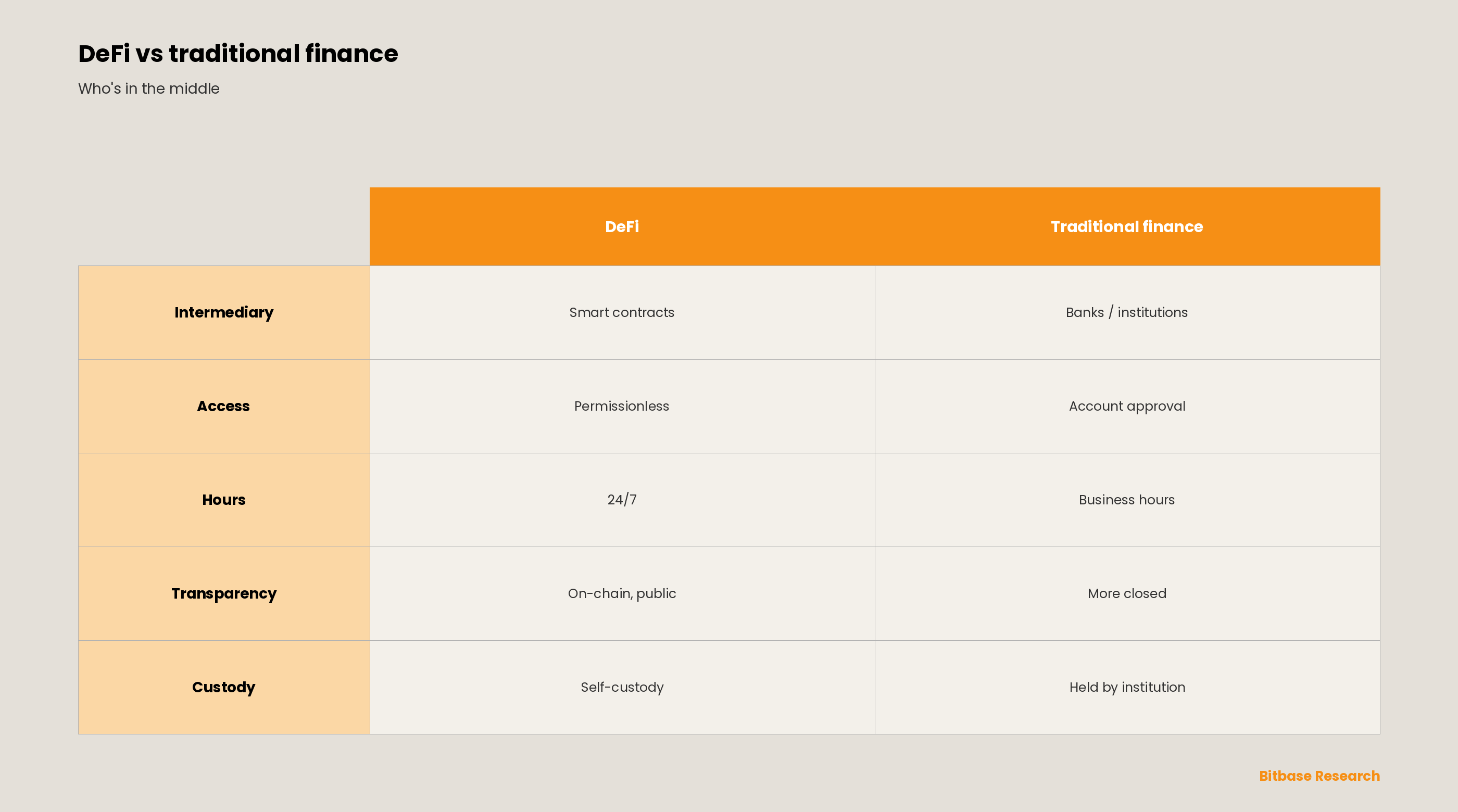
The two systems differ in who sits in the middle.
| Aspect | DeFi | Traditional finance |
|---|---|---|
| Intermediation | Smart contracts and protocols | Banks, brokers and other institutions |
| Access | A crypto wallet connected to the blockchain | An account approved by the institution |
| Hours | Around the clock | The institution's own hours |
| Custody | Self-custody: assets stay in the user's wallet or in smart contracts, not with an intermediary | Usually held by the institution or a custodian |
| Settlement | On-chain, once the transaction is recorded | Through clearinghouses, typically after a delay |
| Transparency | Transactions and contract code can be checked on-chain | Depends on the institution and the market |
| Main risks | Smart contracts, liquidity, oracles, stablecoins and keys | The institution, counterparty default and operational failures |
Opportunities and risks
DeFi lets holders do complex financial operations — saving, lending, insurance — without an institution taking a cut [1]. But it carries risks too: smart contracts can have bugs, prices are volatile, and regulation is still evolving [2]. Loans can be liquidated when collateral falls, oracles can feed in wrong prices, stablecoins can lose their peg, and a user can sign the wrong transaction; running on-chain removes none of these risks [1][2]. Understand the risks before taking part.
Before you use a DeFi protocol
DeFi shifts responsibility from institutions to the user, so a few checks come before the first deposit [1].
- Check which blockchain the protocol runs on, and use a wallet that supports it.
- Move only the assets you plan to use into that wallet.
- Read the protocol's audits and find out who can change its contracts.
- Before you sign, check the network, the contract and the permissions the transaction asks for.
- Start with a small amount and confirm that deposits and withdrawals work.
The bottom line
DeFi is an open financial system that runs on a blockchain and replaces traditional intermediaries with smart contracts. It brings openness and transparency, but also new risks. Understanding it is the first step to reading on-chain finance. To keep learning the fundamentals, follow more from Bitbase Academy.
Frequently asked questions
What is the difference between DeFi and CeFi?
CeFi, or centralized finance, describes firms that operate on blockchains but otherwise look much like traditional financial intermediaries [2]. In DeFi, smart contracts take the place of those intermediaries, and users can keep custody in their own wallets [2].
Is DeFi safe?
No protocol is guaranteed safe. Even audited protocols have suffered losses, and when a protocol fails or is exploited, users typically absorb the full loss, without the layers of customer protection that soften such losses in traditional finance [1].
Related reading
Other Bitbase articles on this topic:
- ICP Swap Explained
- Maple Finance and SYRUP Explained: Why SYRUP Is Not syrupUSDC
- What Is Yield Farming?
Disclaimer: This article is educational content from Bitbase Academy, provided for information only. It does not constitute investment, trading, tax, or financial advice. Crypto assets are volatile; assess your own risk. Written as of October 2026; refer to the latest official information.
References
[1] Stripe, "Understanding Decentralized Finance (DeFi)." stripe.com
[2] Federal Reserve Bank of Boston, "Decentralized Finance (DeFi): Transformative Potential & Associated Risks." bostonfed.org