


Author: Gu Yu, ChainCatcher
If in the past few years the crypto industry's greatest fear was a bug in a blockchain smart contract, then now, project teams should perhaps be more worried about this: an employee is attending a seemingly normal online interview or partner meeting, and has downloaded unsafe software.
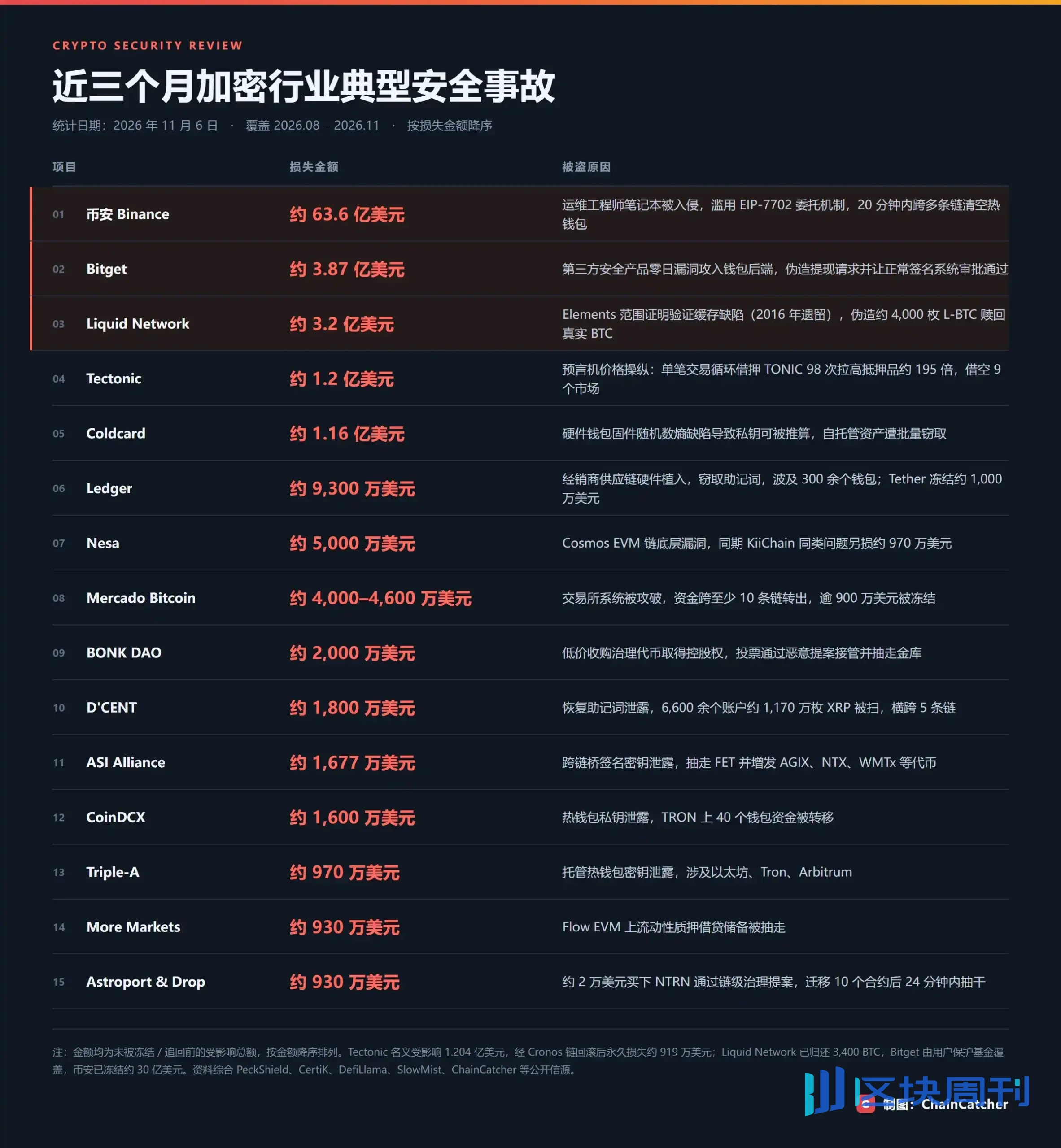
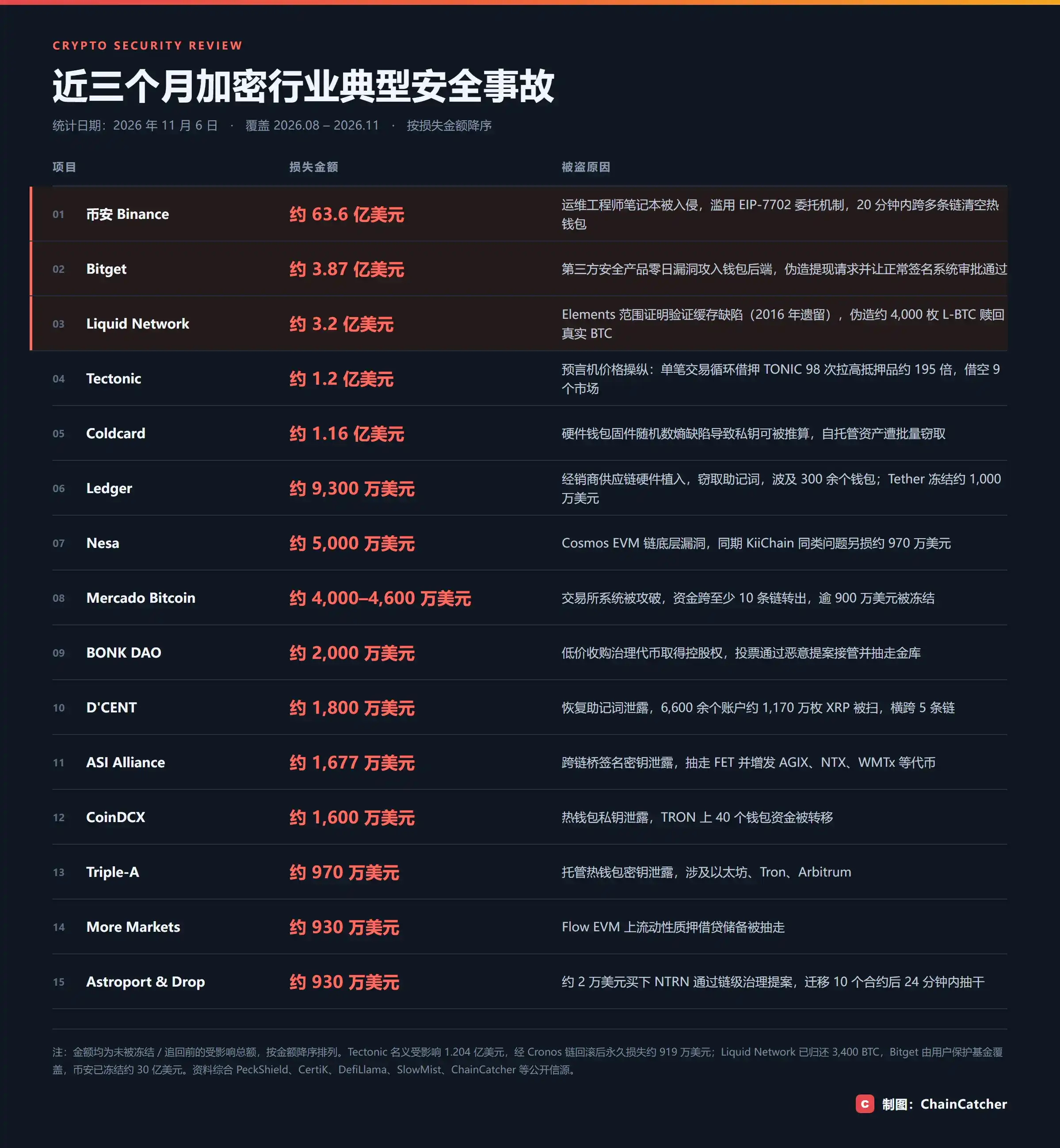
On October 29, Binance, the world's largest cryptocurrency exchange, suffered an unprecedented security incident. Through a multi-stage infiltration, attackers ultimately took control of the exchange's internal wallet signing system, affecting digital assets worth approximately $6.34 billion.
This attack was not a traditional smart contract exploit. According to Binance's preliminary investigation report published on November 3, the attackers had previously used fake recruitment interviews, malware, compromised employee devices, and internal AI tools to gradually gain access to core systems.
More notably, this is not an isolated incident.
In September, Bitget suffered a security incident of approximately $387.5 million, in which attackers breached the backend systems of critical wallet infrastructure and bypassed authorization controls to complete asset transfers; in October, hardware wallets leaking from some of Ledger's Southeast Asian distribution channels were implanted with malicious components, leading to the theft of user assets; and in the first half of this year, projects such as Kelp DAO and Drift Protocol also suffered attacks in the hundreds of millions of dollars.
From smart contracts to centralized exchanges, from employee computers to the hardware wallet supply chain, the crypto industry seems to be facing a security siege that covers the entire industry chain.
I. The most costly vulnerabilities are no longer in the code
In the first decade or so since the crypto industry was born, when the crypto industry talked about "security," most of the time it was talking about "whether on-chain smart contracts have vulnerabilities," which concerns the very foundation of blockchain technology, but today most attacks and destruction come from outside smart contracts..
In CertiK's first-half report, the category with the largest losses was wallet intrusions: 33 cases, $444 million, averaging more than $13 million per case. Phishing ranked second, with 63 cases and $366 million. Although code vulnerabilities occurred 204 times, they accounted for only 11.5% of losses.
"What concerns me most is not the total amount, but the shape of the losses." CertiK co-founder and CEO Gu Ronghui said in an interview with Forbes that nearly half of the losses in the first half were concentrated in two incidents, Kelp DAO and Drift Protocol, totaling about $577 million, "and both stemmed from operational and infrastructure-level failures, not traditional code vulnerabilities."
His explanation was very direct: "Compared with finding vulnerabilities in code, attacking key management, multi-signature governance, and operational infrastructure offers a much higher return."
This path has been demonstrated repeatedly this month. Ledger's problem was not the chip, but the distributors—the devices were implanted before they reached users' hands; Ngrave's problem was not the wallet, but the push notification provider being hijacked, followed by phishing; Polymarket's problem was not its own system, but a script from a British website performance monitoring vendor; Bloom Trading's problem was a remote code execution vulnerability in a third-party module; on October 31, the domains of at least 12 to 15 DeFi websites were replaced with counterfeit sites in the same batch of DNS hijacking.
Governance is no exception. X100 lost $4.85 million through a flash loan combined with a governance takeover; Hifi Finance lost about $1 million after an address funded by Tornado Cash submitted a malicious proposal; Yapeswap's governance attack was even simpler—the quorum was set to zero.
The data reveals the direction in which attack patterns are shifting: Ari Redbord, global policy head at TRM Labs, pointed out that attacks on infrastructure and keys account for only 15% of all incidents but cause 76% of losses.
But more troublesome than "where the money was lost" is what happens after the loss. For most projects, once attacked, the trust of users and the market is irreparably lost, and even established, well-known projects are no exception.
Last November, Balancer lost $128 million in less than half an hour due to a rounding error in its v2 composable stable pool, involving six chains. In August this year, this veteran protocol, which once managed $7 billion, announced a gradual shutdown. The team admitted in an open letter that nearly a year after the vulnerability, they still underestimated its impact on subsequent adoption rates: every subsequent partnership discussion had to begin with explaining that vulnerability, resulting in longer decision cycles and smaller partnership scales.
The cost of a vulnerability is never just the amount stolen. The question follows: since the cost is so clear, why has the defense line not grown thicker along with it?
II. Technology is advancing, but attacks are running faster
Such a severe situation inevitably prompts deep reflection: as technology advances, the crypto industry should be becoming safer and safer, so why is it instead becoming less and less safe?
AI is the most noteworthy factor among them. Over the past year, AI's development has been nothing short of leaps and bounds, with various models flourishing, and while countless crypto companies have integrated AI into their daily workflows, hacker groups have become even more adept at using AI.
In an assessment on October 29, Microsoft said that of the eight North Korean hacker groups it tracks, three have already integrated AI into daily operations, and another four are rapidly expanding their use. They use generative models to mass-forge recruiting companies, customize interview scripts, and even directly assist in vulnerability discovery.
SlowMist founder Cos mentioned a case: Moonwell was hacked for $1.78 million, and the problematic code bore the mark "Co-Authored-By: Claude Opus 4.6"—generated by AI and merged directly into the production environment.
Security researcher Stacy Muur said bluntly: "Crypto security is completely fucked," and "we are entering a rather serious cybersecurity arms race"; Bankless co-founder Ryan Sean Adams warned that AI is giving hackers "dark superpowers," and "we don't have much time left." CZ also said: "The AI industry has not yet managed to make defensive capabilities launch before offensive capabilities," and the industry can only "use AI to fight AI."
A more cutting-edge risk is Agents. Gu Ronghui's judgment is: "An AI Agent with wallet access permissions is essentially a new type of high-privilege key holder. The difference is that its decision-making process may be manipulated by external inputs, and while humans might notice these anomalies, an Agent without sufficient security constraints may not be able to identify them." CertiK recorded an early example: in June, the well-known arbitrage bot JaredFromSubway was lured by a fake arbitrage pool deployed by attackers into automatically approving a malicious contract, losing about $7.5 million.
But attributing everything to AI would miss the other half of the answer. The structural insufficiency of industry security investment is also one of the core factors. Crypto projects generally emphasize marketing over security, audit reports often quickly become invalid after on-chain upgrades, and the lazy screening logic of "check the audit, check TVL, compare APY" has completely collapsed.
Dragonfly partner Haseeb Qureshi's observation provides another perspective: DeFi thefts in 2026 annualize to about $1.89 billion, lower than in 2025, with the number of attacks increasing but the size of individual attacks falling faster—attackers are shifting more toward small protocols and abandoned projects, because large protocols have already completed more hardening. This precisely shows that it is not that the threat has become smaller, but that defense resources are highly uneven: leading institutions have the capital to build defense lines, while long-tail projects are running naked.
The unevenness of defense resources is only one side; the opponents on the other side do not operate according to the cost structure of startups at all—namely, North Korean hackers operating in the form of a state machine.
According to Chainalysis statistics, North Korea-linked hackers stole about $2.02 billion in 2025, with cumulative thefts over the years totaling about $6.75 billion. This is not a ragtag group, but an operational system with a national budget, patience, and planning measured in months—a UN expert panel report explicitly links crypto theft to funding for North Korea's ballistic missile and nuclear weapons development. When the attackers are state actors and the defenders are startups, the nature of this war has already changed.
In addition, new standards are also creating new attack surfaces. In the Binance case, the attackers exploited the EIP-7702 account abstraction authorization mechanism to make hot wallets delegate execution logic to malicious contracts—with every step innovation takes forward, the attack surface expands by another ring.
There are more and more places where the defense line needs to be patched, and the window for patching often only comes after something goes wrong.
III. The Industry Revisits "Security"
Binance's preliminary investigation report on November 3 aired its own dirty laundry, detailing the specific methods the hackers used to carry out social engineering attacks. The report also disclosed that since 2026, Binance's security team has detected and blocked 57 suspected North Korea-related cyber threats, with tactics ranging from fake job recruitment and malware disguised as popular developer tools to tampered software packages and fake video conferencing applications.
Industry discussion quickly shifted from "who did it" to another question: after an employee is deceived and a computer is compromised, what other lines of defense can stop the losses from spreading. The same question applies to other cases this month—Ledger's reseller, Polymarket's third-party scripts, and the batch of DNS hijackings on October 31—none of their entry points were in their own systems.
CoinEx founder Yang Haipo categorized it as three avoidable failures: development and operations environments not sufficiently isolated, production operations lacking a second layer of verification, and signing parties not performing independent verification. His sharpest remark was that if all parties simply trust upstream requests, "even with a multi-signature architecture, it may behave no differently from single-signature"—these measures do not require complex technology; what is lacking is discipline. AltLayer founder YQ reached a similar judgment: such attacks have exceeded the coverage of smart contract audits, and defenders must understand the complete workflow between employee endpoints, internal tools, and production clusters.
But simplifying the incidents into "a few low-level mistakes" is equally dangerous. SlowMist founder Cosine reminded that only after actually suffering an attack can one see how intelligence gathering, malware evasion, exploitation of the trust chain, lateral poisoning, and risk-control bypass are combined—this is an APT process; "seemingly crude methods can still cause serious consequences in the right target and work scenario." BitsLab co-founder Luis was more direct: a lock screen cannot stop background malware already implanted on a device, the cost asymmetry between attack and defense is inherently stark, and AI will continue to amplify this asymmetry.
The two camps actually agree on the conclusion: security is no longer something that an audit report before launch can deliver. Gu Ronghui said the industry now faces not "how to prevent a single vulnerability from being exploited" but a protection system covering the entire asset lifecycle, so that even if one link is compromised, losses are contained locally. Yu Jianing pointed out that a management model centered on pre-deployment audits is already difficult to adapt, and continuous assessment, real-time monitoring, and emergency response need to be incorporated into normalized governance.
One layer further out is the only part of this round of incidents that can be called good news. On October 31, the FBI attributed the attack to North Korea's TraderTraitor operation, and together with the Secret Service and the IRS Criminal Investigation Division published hundreds of involved addresses, calling on THORChain node operators, instant exchange platforms, DeFi protocols, and blockchain analytics firms to block related transactions; issuers including Tether and Circle froze approximately $3 billion in total. When one exchange got into trouble, the entire industry's clearing and issuance links were mobilized within tens of hours.
But collaboration changes the distribution after losses, not the probability of losses occurring. CertiK statistics show that in the first half of the year, funds frozen or returned across the industry amounted to $115 million, accounting for 8.8% of the $1.316 billion in losses; Binance's recovery ratio this time was astonishingly high because what was stolen was mainly stablecoins, whereas for Bitcoin and Ethereum, which have no issuer, the attackers still hold about $2.4 billion.
Conclusion
From smart contract vulnerabilities to compromised employee devices, from intrusions into third-party service providers to AI-assisted penetration, from governance attacks to the long-term positioning of North Korean hacker organizations, the crypto industry is undergoing a profound change in attack patterns.
AI further lowers the cost of attack preparation, professional attack organizations keep increasing the scale and persistence of attacks, and the long-standing insufficient security investment by project teams creates even more opportunities for these attacks.
A project's withdrawals may be paused in time, an anomalous transaction may be frozen by a stablecoin issuer, or an attack may only cause user data leakage and compromise of internal system permissions. But these events all mean that almost all crypto projects have lost control over their security boundaries.
Blockchain can guarantee that transaction records are tamper-proof, but it cannot guarantee that the person initiating a transaction has not been deceived, nor that the key signing the transaction has not been stolen. When attackers begin to bypass code and directly attack people and organizations, the crypto industry needs to reunderstand what real security is.
If the most important innovation of the crypto industry over the past decade was building a value transfer system that does not require trusting third parties, then over the next decade the industry must answer another question: how to truly protect users' assets and trust in an environment full of untrustworthy participants?