Written by: Shaurya Malwa, CoinDesk
Compiled by: Chopper, Foresight News
Deep Tide Introduction: In the extremely cold Nordic winter, energy-intensive Bitcoin mining is evolving into an innovative side business of heat capture. Finnish startup SunBit attempts to convert Bitmain water-cooled mining machines into household boilers, converting nearly 100% of computing power consumption into 60-degree Celsius water heating circulation, and using mining revenue to directly offset heating electricity bills.
However, this "free heating" economic calculation is highly fragile: it not only faces high initial equipment investment of more than $20,000, but is also severely constrained by the network's hash rate difficulty and electricity price fluctuations. More critically, the approaching block reward halving in 2028 means that this business model can only hope for Bitcoin's price to double and break through $130,000 to maintain a slight profit balance.
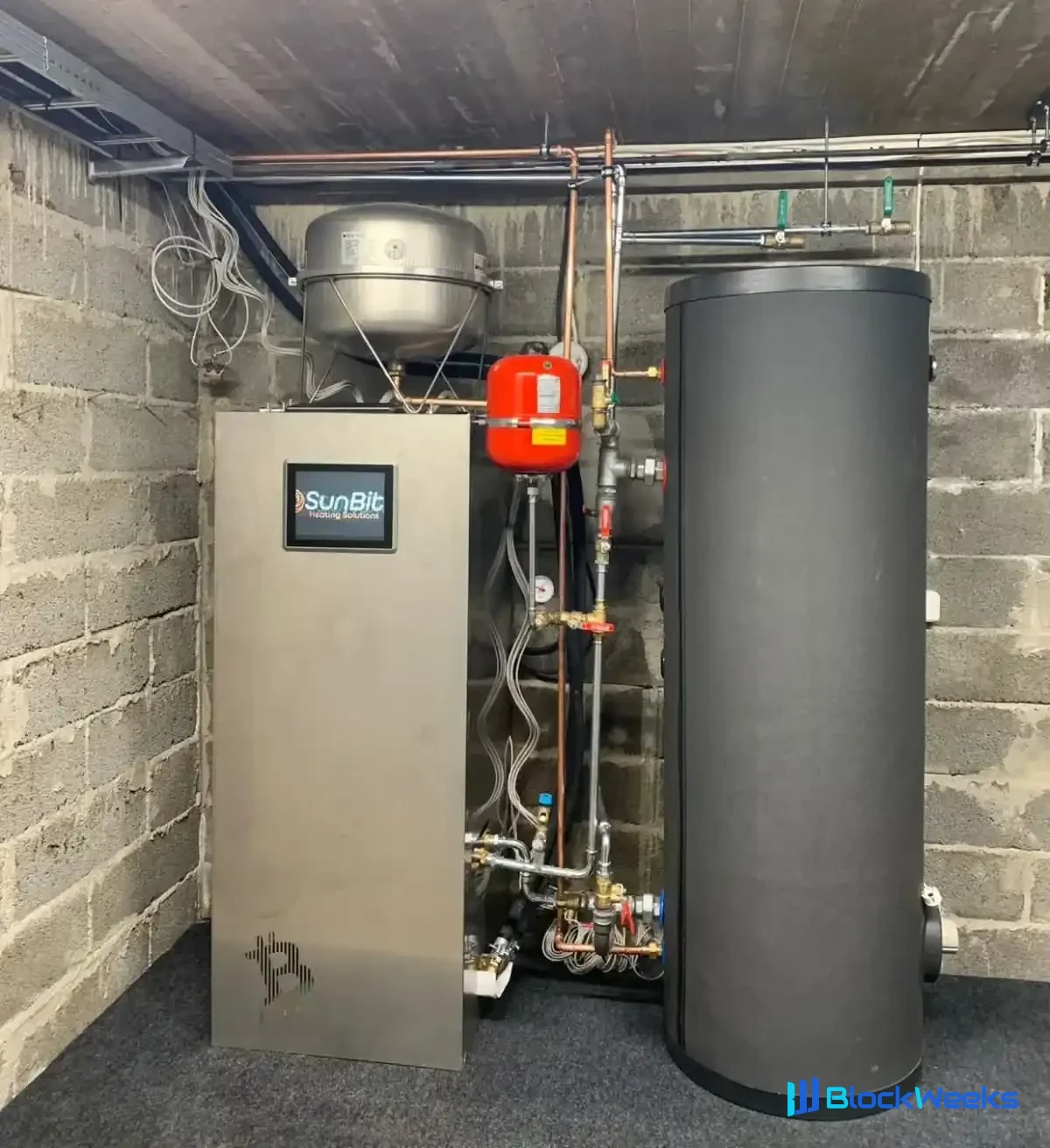
In the small town of Nokia, Finland, a 180-square-meter house has completely cut off district centralized heating and now relies entirely on Bitcoin mining machines for heating.
This equipment is the "Bitcoin Boiler" launched by SunBit. For every 1 kilowatt-hour of electricity consumed by the mining machine, almost all energy is converted into heat. The device stores heat in water, with water temperature reaching up to 60 degrees Celsius, and then delivers it throughout the house through radiators and underfloor heating pipes, similar to the principle of oil and gas boilers, while the machine operates and continuously mines Bitcoin.
Simply put, if the Bitcoin mining revenue can cover the electricity bill, the resident is essentially heating without continuously paying energy costs. But the installation cost of this system is more than $20,000, and whether it can make money depends on Bitcoin's price, electricity price, and the network's hash rate competition difficulty.
SunBit founder Suomi said: "The heating function itself is not affected by market conditions; what changes is only the payback period."
This model also has an unavoidable time node. Bitcoin is expected to undergo its next halving in spring 2028, with block rewards directly cut in half. Many residents may not have recovered the equipment cost before the halving arrives, which will directly impact this "mining heating" business model.
SunBit delivered its first batch of mass-produced Bitcoin boilers in 2025, and currently a total of 30 systems are in operation, CEO Elmeri Suomi told CoinDesk in an interview. Except for one set overseas, all the rest are in Finland, and have been used to replace or reduce the use of gas, oil, firewood, and municipal centralized heating.
In 2025, they landed their first overseas project in Lekkum, Netherlands, using mining machines to replace gas heating. In Kotka, a port city with about 50,000 people on the southeast coast of Finland, a 200-square-meter residence combines mining machines with an existing oil boiler to form a hybrid heating system.
Image: A SunBit device installed in a home in Finland
In an old manor in Tampere, Finland's third-largest city, mining machines have replaced firewood heating, keeping a 1,500-liter water tank between 50°C and 60°C. In a 3,000-square-meter industrial plant in Vimpeli, a similar heating system is also operating, equipped with an air-source heat pump, while also absorbing surplus electricity from a 30-kilowatt solar array.
Finland has become a testing ground for mining waste heat heating. Local company MARA also collects waste heat from mining machines and connects it to the municipal heating network to heat local residents.
SunBit's solution is more geared toward ordinary consumers: homeowners purchase the mining machines themselves, replace the original boiler location, the equipment belongs to the resident, the electricity bill is paid by themselves, and all mined Bitcoin is left to the resident. Mining machines are very noisy and are generally placed in the basement or a separate soundproof room.
The Revenue Account of One Mining Machine
Taking the homeowner in the small town of Nokia as an example, the core is a simple income and expenditure comparison: can mining revenue cover the electricity bill?
SunBit's calculation model uses Bitmain's water-cooled mining machine Antminer S21 XP Hydro, with a hash rate of 495T, equipped with third-party firmware Braiins OS. The equipment runs 24 hours a day, with a power of about 5.3 kilowatts, consuming about 46,400 kilowatt-hours of electricity per year. At an electricity price of 11 cents per kilowatt-hour, the annual electricity bill is about $5,200.
Assuming a Bitcoin price of $82,000 and a network hash rate of 1040 EH/s. Under these conditions, one mining machine can mine about 1/12 of a Bitcoin per year. After deducting SunBit's 10% service fee, the homeowner receives Bitcoin worth about $6,100; the mining pool also deducts another 0.5% fee.
This service fee is optional and includes 24/7 remote monitoring, automatic optimization strategies following Finland's floating electricity price, a companion mobile app, and will later add grid peak-shaving functionality. If this service is not purchased, the homeowner can receive the full 1/12 Bitcoin, worth about $6,800 per year.
With the paid service, after deducting the electricity bill, there is still a surplus of about $900, and the accompanying heating is essentially free. Of course, ordinary homes cannot fully consume all the heat produced by the mining machine.
Suomi told CoinDesk, "Currently, the revenue brought by each kilowatt-hour consumed by mining is slightly higher than the electricity price, so the heat is essentially a free byproduct." At the time of the report, Bitcoin's price was about $81,500. SunBit's break-even point (mining revenue after deducting service fees just equals electricity bill) is about $70,000. This figure does not include the purchase cost of the equipment itself and assumes the network hash rate remains unchanged. If more mining machines come online, the revenue per mining machine will decline.
Suomi provided a screenshot of the mining pool backend of an early customer who bought a water-cooled mining machine S21+ Hydro with a hash rate of 358T. In the past year, it mined 0.039 Bitcoin, worth about $3,160 at the market price at that time. This equipment can replace about 2,000 liters of heating oil per year. SunBit can only view data from the first batch of pilot users; subsequent customers use independent private mining pool accounts, and the platform cannot see the data.
Better Than Oil Boilers, But No Match for Heat Pumps
SunBit calculated a comparison for reporters: a detached house consumes 2,300 liters of heating oil per year, with oil price at about $2.19 per liter, and annual oil cost of about $5,000.
Switching to mining machine heating can theoretically save this fuel expense. According to model calculations, after deducting the electricity bill, there is still an annual surplus of about $920. The installation quote for the entire equipment is about $20,200, excluding additional configurations. Excluding maintenance and loan interest, the payback period is about 3.5 years. On the coldest days, the original oil boiler can be kept as a backup.
But there is a shortcoming here: more than half of the heat cannot be used by the house. The equipment's external dry cooler (a heat dissipation device with a fan) will directly discharge excess heat outdoors, especially noticeable in summer (late May to mid-September in southern Finland). Finland's heating season is long, with about 100 days of severe cold in the southwest and up to 200 days in Lapland.
Air-source heat pumps are the stronger opponent. For every 1 kilowatt-hour of electricity consumed by a heat pump, it can transfer heat from the air and soil, producing 2.5 to 3 kilowatt-hours of heat energy; while a mining machine can only convert 1 kilowatt-hour of electricity into 1 kilowatt-hour of heat.
For example: a house needs 25,000 kilowatt-hours of heat per year. SunBit estimates that the annual operating cost of an air-source heat pump is about $1,100, and municipal centralized heating is about $3,170. If the mining machine does not run all year round but only runs just enough to meet the 25,000 kilowatt-hour heating demand, the mining revenue after deducting electricity costs can still earn an extra $490.
The trade-off between the two is clear: heat pumps use less electricity and have higher heating efficiency; mining machines consume more electricity, but mining revenue can offset electricity costs. The advantage of mining machines comes entirely from mining profitability, not from heating efficiency itself.
Suomi said mining machines have more advantages in severe cold: "The heat production capacity of mining machines is not affected by outdoor temperature. Air-source heat pumps' efficiency plummets at low temperatures of minus 25°C, but mining machines are different: 365 hours a year, every kilowatt-hour of electricity is stably converted into heat up to 60°C." But the operating revenue of mining machines is firmly tied to Bitcoin market conditions and network mining difficulty, while heat pumps are completely unaffected by coin prices. The installation price range for the entire equipment is $20,400 to $31,400, with an estimated payback period of 3 to 6 years.
The 2028 Halving Is the Biggest Risk
Users who order and install now will most likely encounter the 2028 Bitcoin halving before they recover their costs. Block rewards will drop from 3.125 Bitcoin per block to 1.5625.
SunBit's profit calculator does not take the impact of the halving into account; it only estimates the payback period based on current mining revenue. Whether the coin price is $100,000 or $20,000, the company will not promise a fixed return.
Suomi said: "I will not predict the coin price or the hash rate trend. We will explain the halving history clearly to every customer and tell them what kind of impact the halving has had on revenue in the past."
Under the premise that the original calculation conditions remain unchanged, after the halving, the mining revenue corresponding to each kilowatt-hour of electricity will drop from 13 cents to 7 cents, which is lower than the electricity price of 11 cents. At that point, heating will have to be paid for out of pocket, at a cost of about 4 cents per kilowatt-hour of heat, close to the operating cost of an air-source heat pump of the same efficiency.
Households that install the equipment this winter will probably still have about 18 months to enjoy the current high profit margin. Calculated according to this formula: to continue achieving "free heating" after the 2028 halving, the Bitcoin price needs to rise to about $131,000.
So these dozens of houses in Finland have a special heating solution: betting on Bitcoin to keep rising in price.