




Author: Kuli, Shenchao TechFlow
Shenchao Introduction:
On November 9, Aave DAO passed the Babylon proposal with 100% of votes in favor. Native Bitcoin can be used as collateral on Aave V4 to borrow stablecoins without wrapping, without cross-chain, and without third-party custody, with a collateral ratio set at 78%. The proposal also specifies revenue sharing: Aave DAO first takes the first $500,000 each year, and only the excess is shared with Babylon, and 4% to 7% is used to buy back AAVE and BABY.
Bitcoin is entering the largest lending market on Ethereum in its native form.
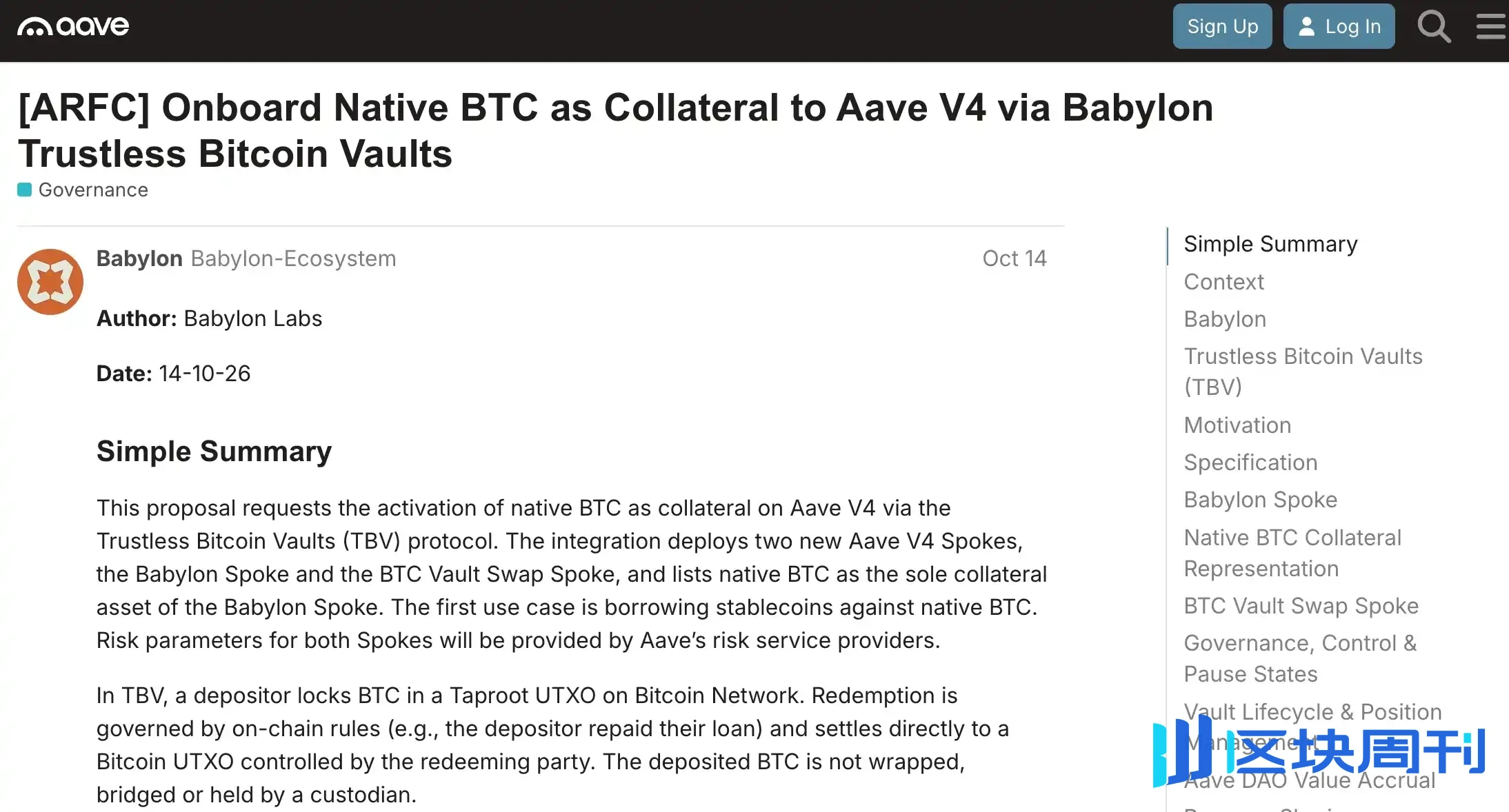
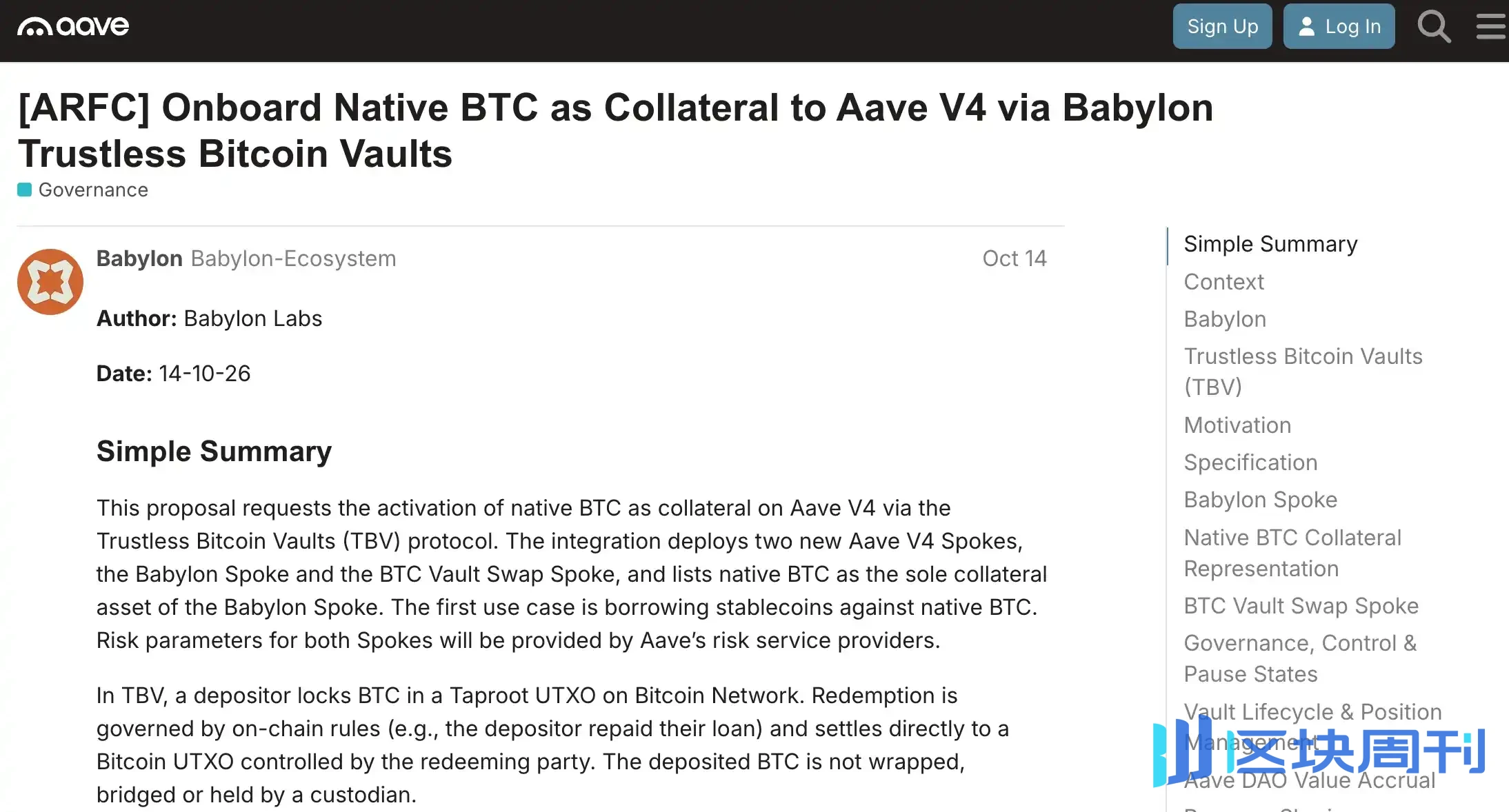
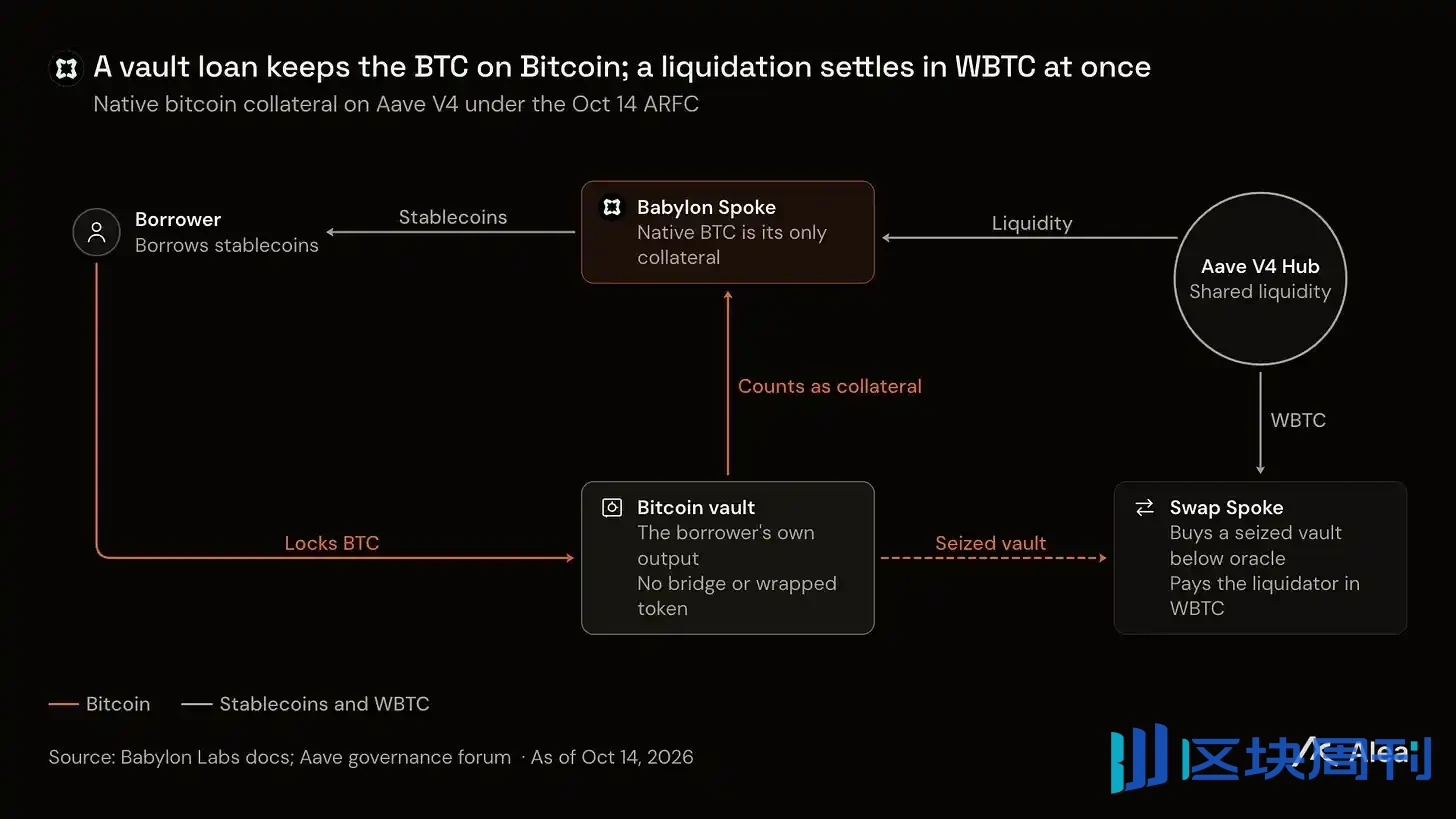
According to a message posted by Babylon officially on X on November 9, Aave DAO passed the ARFC proposal with 100% of votes in favor, agreeing to connect native Bitcoin to Aave V4 as collateral through Babylon's "trustless Bitcoin vault" (TBV). Bitcoin holders can lock BTC while controlling their own private keys and borrow assets such as USDT and USDC. The proposal next enters the AIP stage, that is, the final on-chain execution vote, with the mainnet target set to launch by the end of 2026, and initially limiting the number of participants and scale, opening up in phases.
This proposal was first submitted in May, and passed the community temperature check in June, when there were 299,743 AAVE in favor and zero against.
Aave founder Stani Kulechov expressed support on the forum on October 14, the day the formal proposal was published. According to previous statistics by Shenchao TechFlow, of Aave's 74 binary Snapshot proposals this year, 73 were passed.
Bitcoin enters in native form for the first time, with collateral conditions comparable to WBTC
According to the proposal published on the Aave governance forum, borrowers lock BTC into a Taproot vault on the Bitcoin chain, and the coins always remain in an address under their own name. A non-transferable accounting token is generated on Ethereum, with the same amount as the locked Bitcoin, serving as collateral proof in Aave V4.
Among the parameters given by risk control institution LlamaRisk, the collateral ratio for native BTC is 78%, with a maximum liquidation bonus of 5.55%. According to PANews, the collateral ratio and borrowing rate on this line are comparable to wrapped assets such as WBTC and cbBTC in the Aave V4 core market.
This arrangement fills the long-standing custody gap in Bitcoin lending. According to Cointelegraph, Aave's existing Bitcoin collateral is mainly wrapped assets such as WBTC and cbBTC, and the underlying Bitcoin must be kept by custodians, so users bear counterparty risk. According to previous reports by Shenchao TechFlow, Aave has already deployed a dedicated LBTC market, and this Babylon proposal is the first solution aimed at native Bitcoin that is not wrapped.
There is also a cost advantage. According to Alea Research, Babylon estimates that the annualized cost of vault borrowing is between 3% and 5%, while the common range for centralized lending platforms is 9% to 16%. As of the end of the third quarter, about 40,481 Bitcoins were staked on Babylon, all remaining on the Bitcoin chain in script form.
Revenue sharing sets a $500,000 threshold, with a buyback ratio of up to 7%
The proposal's revenue distribution adopts a tiered design.
According to the original proposal, only two items of revenue are counted in the sharing: the liquidity fees collected by Aave from the interest paid by borrowers on this Babylon line, and the fees generated in the liquidation process. The first $500,000 each year all goes to Aave DAO. In the $500,000 to $2 million tier, Aave DAO takes 78%, Babylon takes 18%, and 4% is used for buybacks. After that, it rises tier by tier; for the portion above $6 million, Aave DAO takes 61.5%, Babylon takes 31.5%, and the buyback ratio rises to 7%.
Buyback funds purchase tokens on the open market, 85% buying AAVE and 15% buying BABY, and the purchased tokens are split equally between Aave DAO and the Babylon Foundation.
Research institution Alea Research has made an estimate: if this line's annual revenue reaches $10 million, Aave DAO would receive about $6.92 million, Babylon about $2.52 million, and buybacks about $560,000, of which about $84,000 would be used to buy BABY. Alea Research points out that this will be the first time BABY has a value channel derived from borrower interest.
However, when viewed alongside the existing scale of the two tokens, this buyback is limited in significance. According to a proposal passed on the Aave governance forum in March, AAVE's own annual buyback budget has been lowered from $50 million to $30 million. On the BABY side, according to Alea Research statistics, about 1.58 million new tokens are added each day, and at third-quarter prices, the value of new tokens each year is about $7 million.

Initial quota about $21 million, liquidation still relies on WBTC
Whether the scale can grow is the hurdle this proposal must pass next.
According to the original proposal, the initial credit line provided by Aave's core pool to this Babylon line is: $8 million each for USDT and USDC, $2 million each for USDG and RLUSD, and $1 million for GHO, totaling about $21 million. The native BTC collateral cap is 300 coins. The quota will later be increased with demand, but each increase must be approved by Aave DAO. According to Alea Research statistics, the effective loans of the entire Aave V4 in September were about $310 million.
The liquidation mechanism is another focus. Because Bitcoin remains on the Bitcoin chain, the proposal specifically sets up a liquidation settlement module: liquidators use WBTC to buy the seized vault, and then arbitrageurs redeem BTC on the Bitcoin chain. This means that the collateral process gets rid of reliance on custodians, but the liquidation process still relies on custodial assets such as WBTC.
On risk control authority, according to the original proposal, emergency suspension is controlled by a 3/5 multisig composed of Aave Labs, LlamaRisk, Babylon, and others, and there is no timelock for suspension and resumption. During suspension, repayment and liquidation are also blocked. The multisig has no authority to transfer users' Bitcoin.
There are two subsequent time points worth watching. According to Alea Research, Babylon plans to submit the adjustment plan for BABY token economics to governance before the end of November, with the direction being to let new issuance flow more to the vault business. At the same time, about 2,999 BTC staked under Gate custody will mature around November 30; if not renewed, Babylon's staking scale will change accordingly.
Before the mainnet launch, whether the BABY token economic adjustment can be implemented will determine how much real buyback this native Bitcoin lending business can ultimately bring to the two tokens.