




TL;DR
- Shorts are piling up on derivatives exchanges: Open Interest hit $28.18 billion as Bitcoin slipped to $79,756.
- Hyperliquid is hot on the heels of XRP Ledger in stablecoin inflows: $34.1 million vs. $34.4 million in 24 hours.
- Ripple secures final OCC approval for its national trust bank and expands its BNY partnership, while Kraken launches CFTC-regulated perpetuals on Hyperliquid.
- The Fed meeting will set Bitcoin’s direction: a hold above $80,000 targets $85,000, a drop below $79,000 opens $75,000.
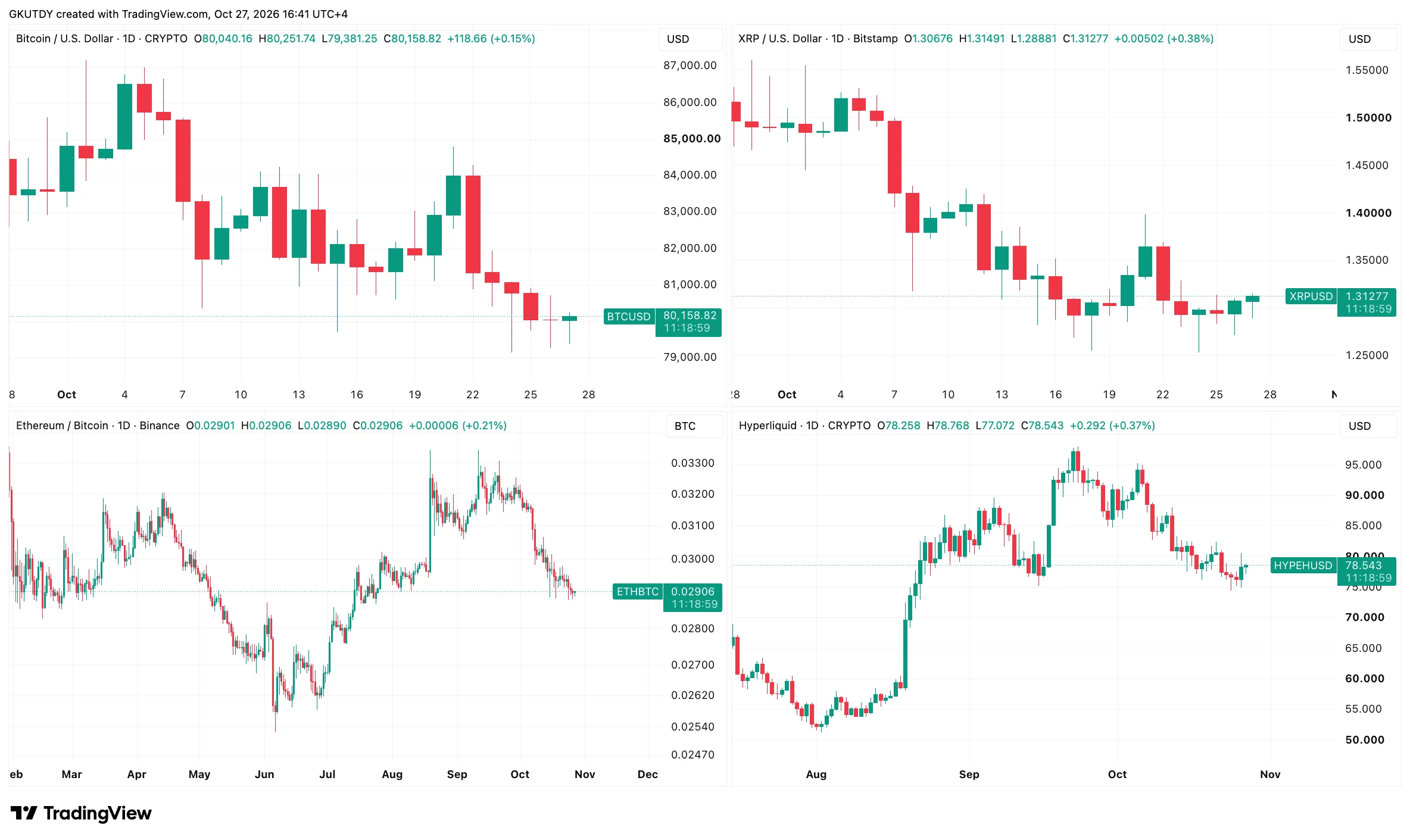
On Tuesday, October 27, an aggressive buildup of short positions is underway on the cryptocurrency market. While Bitcoin's spot price is declining in a narrow trading corridor around $79,756.00, aggregated Open Interest accelerated its growth toward the $28.18 billion mark.
CryptoQuant's Maartunn records a classic bearish divergence — futures contracts are being opened against the spot, which points to a massive entry of short sellers and prepares the market for a sharp forced closure of positions in either direction.
The BTC market dominance index holds a firm line at 60.06%, drawing liquidity away from altcoins. Ethereum dipped to $2,311.16, and traders are hastily parking capital in USDT and USDC stablecoins before the opening of U.S. exchanges.
The CoinGlass summary confirms local tension: over the past 24 hours, the market forcibly closed 66,287 positions worth $140.79 million, with 56.9% of the losses falling on longs. BTC futures ($31.82 million) and ETH futures ($24.06 million) lead in margin call volumes.
Meanwhile, a large-scale withdrawal of coins from exchanges is underway on the spot market. A large whale, dormant for the past 5 months, withdrew 11,330 BTC (about $903 million) from Binance to two new cold addresses. This is a direct removal of supply from exchange order books. Glassnode's on-chain metric confirms this: the share of short-term holders (STH) in profit fell to a healthy 70%, completely removing the previous overbought condition.
Against this backdrop, Coinbase CEO Brian Armstrong reminded that laboratories have already learned to synthesize gold, but Bitcoin's hard algorithmic limit of 21 million coins cannot be changed. The short-term flat is caused by anticipation of macroeconomic statistics from the U.S., while a fierce battle for liquidity is underway in the real-world asset (RWA) tokenization sector.
Behind the scenes of tokenization: Hyperliquid is hot on the heels of XRP Ledger in the battle for stablecoins
The race for control over RWA infrastructure has reached peak speed. According to RWA Foundation, which cites Token Terminal, over the past 24 hours, the three leading blockchain ecosystems attracted $99.6 million in net stablecoin inflows, which instantly go toward backing new tokenized platforms.
Daily inflow statistics show that the decentralized protocol Hyperliquid has effectively caught up with Ripple:
- XRP Ledger (XRPL): Maintains its lead with a daily inflow of +$34.4 million.
- Hyperliquid (HyperEVM): Recorded a surge of +$34.1 million, narrowing the gap to a symbolic $300 thousand.
- Arc: Holds third place with +$31.1 million.

Venture capital is distributing resources between XRPL and Hyperliquid, but the newcomer's aggressive expansion makes its margin market extremely dangerous. Still, the minimal gap between the networks guarantees that the leader in the RWA sector can change at any moment.
A characteristic marker: the largest single liquidation of the day across the entire crypto market — a $1.85 million BTC short position — was recorded precisely on Hyperliquid.
Ripple opens a bank, Kraken leads institutions into DeFi: what else happened on the market this morning
The shift in the balance of power across networks is directly linked to the latest regulatory decisions in the U.S.
The Office of the Comptroller of the Currency (OCC) granted final approval for the launch of Ripple National Trust Bank (RNTB). The supervised bank is being created for a specific task — managing the reserves of the RLUSD stablecoin and providing custody for corporate clients. This gives XRP Ledger a powerful legal advantage over unregulated DeFi competitors.
Ripple is also expanding its collaboration with BNY across custody and tokenized trade finance, bringing trade finance to the XRP Ledger. The partnership combines BNY’s institutional scale with the RLUSD stablecoin, XRP and the XRP Ledger, further strengthening the network’s position in the race for RWA infrastructure.
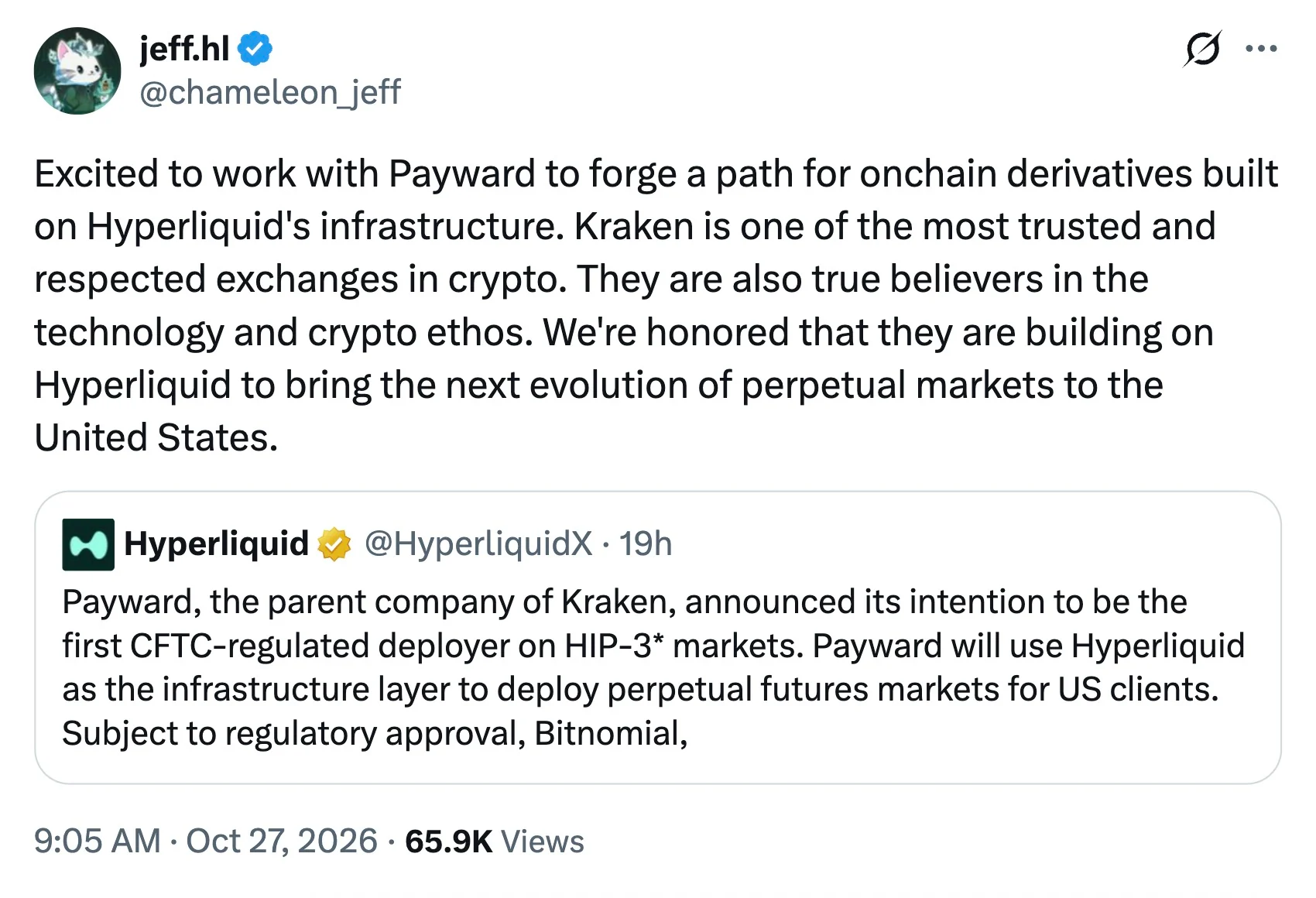
At the same time, the Kraken exchange is rolling out the first CFTC-regulated perpetual futures markets for U.S. clients, built directly on Hyperliquid. The Payward project involves the Bitnomial platform and clearing from NinjaTrader. The integration became possible thanks to the HIP-3 update, which introduced on-chain whitelists for large-capital compliance. Against this backdrop, the HYPE token instantly reacted by rising to $78.50.
Meanwhile, U.S. agencies are restructuring supervisory policy. According to Eleanor Terrett, the CFTC is making the rules for using AI in algorithmic trading its focus topic this week.
"Wall of fear": where may Bitcoin go after the Fed meeting
While Bitcoin is gathering strength in a sideways range, the XRP futures market received a harsh cleanup (deleveraging signal). Open interest on Binance fell 28% from its autumn peaks — to $445 million, dropping below the 180-day moving average. A local price drop of 17% completely washed out retail speculators' leverage through a cascade of margin calls.
Historically, this marker is a signal for growth: in August, a similar market cleanup led to a 72% XRP rally, and in September — to a 32% rally. Stabilization of the token above $1.30 is preparing a foothold for a technical rebound.
Venture investor Chris Burniske notes that long-term players are now aggressively buying up the undervalued long-tail segment. The vector of the medium-term movement of Bitcoin and the entire market will be fully determined by macroeconomic reports from the U.S. at the end of October.
Investor's macroeconomic calendar for this week:
- FOMC meeting: The Fed's interest rate verdict will determine liquidity in risk asset markets.
- Preliminary U.S. GDP for Q3: The data will show the real resilience of the U.S. economy and adjust funds' expectations.
- PCE inflation index (Core PCE): The Fed's core inflation indicator will be released simultaneously with jobless claims statistics and will traditionally trigger futures squeezes.
- Chicago PMI index: The final marker of business activity in the industrial sector will close the week and complete the formation of major players' positions.
Bitcoin movement scenarios ($79,500 – $80,000):
- Bullish scenario ($82,500 – $85,000): An impulsive breakout of the psychological $80,000 mark. Drivers: dovish Fed rhetoric, a decline in PCE inflation, a spot supply deficit after the whale's $903 million withdrawal, and the unloading of the STH holders' selling zone.
- Bearish scenario ($76,500 – $75,000): Loss of the local support level at $79,000. Trigger: harsh hawkish statements from U.S. regulators, which will provoke a new cascade of long position liquidations.
The market is coiled ahead of the release of key statistics. The cleansing of XRP futures of margin froth, the unloading of Bitcoin's selling zones to 70% according to Glassnode, and the systematic movement of coins to cold wallets are laying the groundwork for a move.
The growth of open interest against the backdrop of a local decline in BTC's spot price indicates a critical compression of the spring before an impulsive exit from the range. The final trigger will be the U.S. reports, and the signal for the start of a directional trend will be Bitcoin holding above $80,000.