Author: Gelong
The US midterm elections have concluded, and the Democratic Party's "blue wave" swept both chambers of Congress, while also casually taking the governorships of Texas, Georgia, and other states that are key hubs for AI data centers.
The global AI computing power sector fell immediately in response, Nasdaq chip stocks were decimated, the Nikkei dropped, and A-shares and Hong Kong stocks were not spared either.
But interestingly, after the drop, the reactions of governments around the world were completely on different scales.
Other markets fell, no emergency meetings were held, and no important officials made statements.
Only South Korea: the Deputy Prime Minister and Finance Minister held an emergency market meeting, the Chairman of the Financial Services Commission was present, and the Deputy Governor of the Bank of Korea attended; after the meeting they announced: the maintenance obligation for securities firms' credit financing guarantee ratio of 140% would be exempted for three months.
On the same day, the Korea Exchange activated the Sidecar circuit breaker mechanism, suspending programmatic selling.
Why did South Korea panic so much?
Can't Hold On?
First, look at a set of data.
According to statistics from KOSCOM, a subsidiary of the Korea Exchange, in the month before the crash, that is, from October 6 to November 5, South Korean individual investors net bought Samsung Electronics 5.83 trillion won and net bought SK Hynix 3.36 trillion won.
These two figures ranked first and second among all listed stocks and ETFs in South Korea.
Note the time window!
This was not trend-chasing when the AI frenzy first started at the beginning of the year, this was bottom-fishing on the eve of the crash.
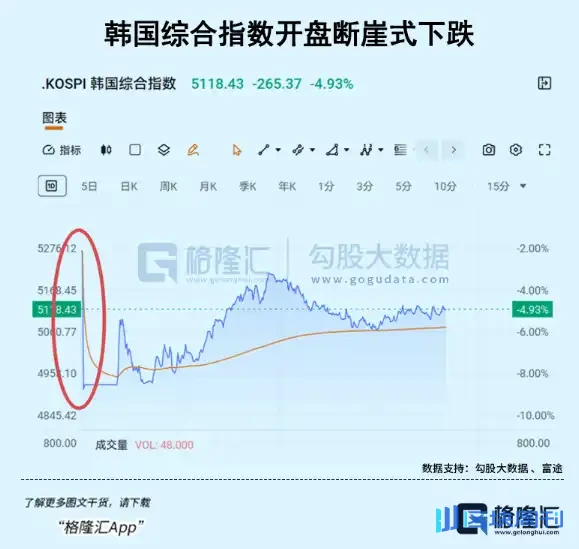
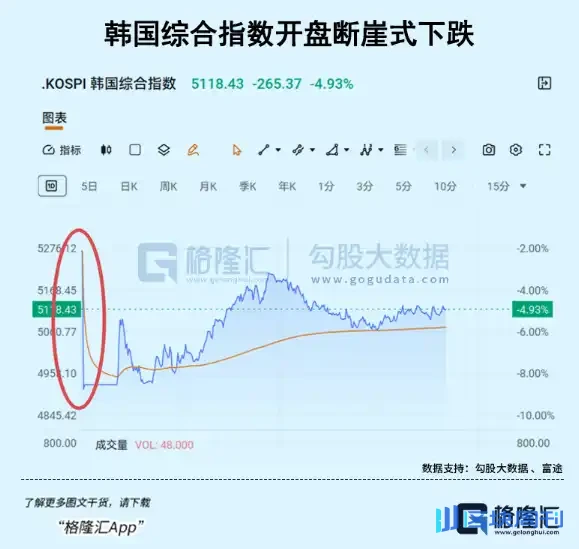
On November 5, KOSPI had already fallen 5.28%, and retail investors were still rushing in.
The next day at the open, KOSPI directly broke through 5000 points.
What is the nature of this money?
The term South Korean media themselves use is: Ant Army.
Behind it, a large amount is borrowed money.
South Korean retail investors are known globally for being aggressively leveraged, and single-stock leveraged ETFs are their handiest tool.
In July this year, South Korea's Financial Services Commission was already forced to act:
The margin threshold for single-stock leveraged ETFs was raised in one go from 10 million won to 30 million, new product listings were suspended, and advertising was banned.
By August, they added more:
New retail investors who want to trade leveraged ETFs must first do 5 days of simulated trading, totaling 5 hours, otherwise they cannot open an account.
The regulators were already this anxious in July, which shows what?
It shows that retail investors' leveraged positions, had already grown so large that even the authorities were afraid.
The data from the Korea Capital Market Institute is even more direct:
As of mid-June, individual investors had cumulatively net bought single-stock leveraged ETFs amounting to 8.2 trillion won, accounting for 60% of the assets under management of such products.
In other words, 60% of the money in leveraged ETFs belongs to retail investors.
Then in the July decline, the 14 single-stock leveraged ETFs tracking Samsung and Hynix saw their assets under management shrink directly from 15.9 trillion at the end of June to 9.3 trillion, evaporating 41%.
The four leading products suffered valuation losses of 8.8 trillion won in less than two weeks.
This is not a pullback, this is leveraged positions being buried alive.
Above the retail investors, there is another layer.
The National Pension Service of South Korea, the world's third-largest sovereign pension fund, is South Koreans' retirement money.
How heavily is it positioned in Samsung and Hynix?
As ofOctober15,the287listed companies in whichNPSholds5%or more saw theirholdings' market value fall from515trillion won at the end ofJuneto333trillion won, a shrinkage of182trillion won, equivalent to about1370hundred million US dollars.
KOSPIhad just hit a record closing high of9114points onJune22, and by mid-Octoberit had already fallen39%.NPS's holdings were carried all the way down from the high, and it didn't get out.
So the situation the South Korean government faces is:
Millions of retail investors charged in at the high with leverage, the national pension fund is heavily overweight the same batch of stocks and deeply trapped,and a handful of stocksaccount forhalf of KOSPI's market value.
At this point word came from the US side that the Democratic Party wants to block data center power and approvals,AIcomputing power expansion may slow,stock pricescan't hold up,and then comes a negative chain reaction.
If thischain reaction cannot be cut off in time, the next stepis a liquidity run.
The South Korean government's exemption of securities firms from the margin collateral ratio obligation is precisely about cutting off this cycle.
Why?
South Korea's stock market is essentially notjust acapital market,but alsoan amplifier of social sentiment.
South Korea's nationwide stock-buying frenzy is famous around the world.
Since the beginning of this year, thanks to precisely catching theAImemory chip tailwind,millions of ordinary South Koreans have bet the wages they saved for years, their marriage money, and even borrowed funds ontwonational stocks.
Butthis kind of sentiment, inSouth Korea's political logic,is a very high-risk matter.
South Korean politiciansknow better than anyone thatoncethe stock market crashes,the resulting tsunami of public opinion is more direct than any diplomatic crisis.
There is another layer, which istheKorean won.
South Korea is a small open economy, and the Korean won is not a safe-haven currency.
When globalrisk-off hits, foreign capital withdraws from the South Korean stock market faster than anyone, and while withdrawing it sells Korean won and buys US dollars, and the exchange rate collapses along with it.
South Korea is also a country that relies almost entirely on imports for energy and raw materials, so once the Korean won depreciates, imported inflation immediately rears its head.
Stocks fall+ currency depreciates + inflation rises, this triple-kill combination is fatal for an economy of South Korea's size.
There is also an additional layer of logic here, namely the importance of foreign capital to the South Korean stock market.
As ofJune2026, foreign investors held about37.8%—38.9%of the total market value of the South Korean stock market, of which US investors accounted for about42%of foreign holdings.
Foreign holdings in core tech stocks such as Samsung Electronics andSKHynix had long exceeded60%, and by earlyAugustthey were still about46.70%and50.84%respectively,onlybyearlyOctoberdid theyfallto46.38%and49.59%.
In terms of trading scale, this dependence is amplified to the extreme.
As ofOctober14, foreign investors had cumulatively net sold about203.7trillion won in South Korea's KOSPI main board market this year, of which Samsung Electronics andSKHynix alone were net sold about176trillion won, accounting for86%of total foreign selling; this year foreign capital withdrew about1310hundred million US dollars from the South Korean stock market, the most among major Asian markets.
South Korea's domesticcapital is limited,and without foreign capital's help it would be hard to have the crazy rally seen in the first half of the year, but foreign capital can come in and can also go out; South Korean stocks are just its arbitrage venue, by no means its final destination.
More seriously, South Korean retail investors and institutions are less sensitive than foreign capital; the latter has the ability to lie in wait when the market is low, while the former often enters only after the market has already risen, and once foreign capital pulls out, they become the ones holding the bag at the top.
So when South Korean government officials come out to speak, they are speaking not only to retail investors but even more to foreign capital:
Don't run, the fundamentals are fine, we can hold it up!
Deep-seated detonation
In the final analysis, the US midterm elections are just a match, and South Korea's economic structure is thefundamentalreason the fire got out of control.
By comparison,Japan has cars, precision machinery, and general trading companies; if the TOPIX falls, Toyota and Sony won't collapse together.
The US has the world's largest domestic demand market and tech ecosystem,even ifthe Nasdaq falls, Apple,Microsoft,Google,and meta's stock priceswon't all be halved at the same time.
What about South Korea?
It's not that it has no other industries, but its dependence on semiconductors is simply too great.
In2025, South Korea's semiconductor exports were1734hundred million US dollars, accounting for24.4%of South Korea's total exports.
InJanuary2026, the share of South Korea's semiconductor exports in total exports exceeded30%for the first time, reaching31.2%.
ByMay, this figure had jumped to42.3%, a record high.
In early October, semiconductors' share of exports further approached47%.
In other words, South Korea's export growth is almost entirely propped up by chips,and all other categories combined are shrinking.
Looking at more detailed data,within South Korea's semiconductor exports, memory chips account for75%, system semiconductors account for only20%, and wafers and components account for5%.
Here's another data point:GDPincrement.
In the third quarter of2026, South Korea'sGDPgrew1.0% quarter-on-quarter, nearly three times the central bank's previous forecast,and computers and electronic equipment, including semiconductors, contributed about60%of theGDPincrement,of which50%was contributed by thesemiconductorindustry.
Half of a country's single-quarter economic growth comes from one industry.
And the products of this industryarehighly concentrated in memory chips, with customers highly concentrated among American tech giants, and demand highly tied to theAIcapital expenditure cycle.
Morgan Stanley data shows that in South Korea's exports to the United States, the share of automobiles fell from36%in2024to13%, while the share of semiconductors soared from10%to28%.
Morgan Stanley evendirectly calls South Korea's exports to the United States a leading indicator of U.S.AIinvestment,with South Korean exports leading U.S. equipment investment indicators by one to two months.
The tighter this binding, the greater the shock to South Korea when U.S. policy shifts.
Conclusion
Facing the same policy headwinds, stock markets fell sharply.
Butlook,other marketsfell, yes they fell,butthey kept trading and kept hedging.
OnlySouth Korea fell,and the deputy prime minister came out to hold meetings, the financial committee came out to issue statements, the exchange pulled the plug, and brokerages were told not to allow liquidation.
This is not rescuing the market, this is firefighting.
The result of over-betting on a single export industry is thatwhen America sneezes, South Koreacatches abad cold.
Moreover,this time America isn't sneezing, it's aiming at theAIinfrastructure's vital point,anddelivering a vicious kick.
Tell me— if South Korea isn't panicking, who is?