On November 9, 2026, at the regular press conference of the Ministry of Foreign Affairs. An AFP reporter asked: Reuters reported that about 600,000 advanced NVIDIA artificial intelligence chips are stored in Hong Kong, waiting to be shipped to mainland China; despite demand from technology companies, the Chinese side has refused to approve large-scale imports. Spokesperson Guo Jiakun's answer was only one sentence: "China's position on the issue of U.S. chips exported to China is consistent. For specific details, I suggest you ask the competent Chinese authorities."
On the same day, a Bloomberg reporter followed up on "how China would respond if the United States adopts stricter chip restrictions," and received a word-for-word identical answer. No confirmation of the quantity, no explanation of the criteria, no response to "where the blockage is."
But this ambiguity is more informative than an explicit statement. Over the past three years, the keyword for China's AI industry has been "can't buy chips," with the restriction in Washington; now about 600,000 H200s that have already obtained U.S. export licenses are sitting in Hong Kong warehouses, and the signature line is in Beijing. The United States has already let them through; Beijing has not put pen to paper. U.S. Commerce Secretary Lutnick said bluntly at a Senate Appropriations Committee hearing on April 22, 2026: "I can tell you clearly that, to date, they have not bought a single chip."
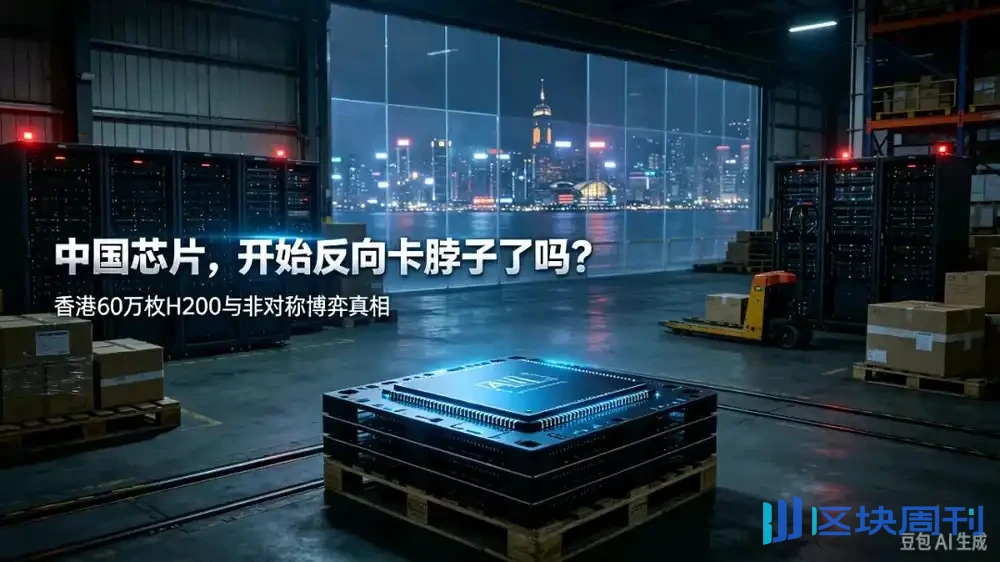
This picture is easily read as a clean narrative reversal. But "reverse chokehold" as a judgment needs to be precisely taken apart: China has indeed gained the ability to say "no" at several asymmetric nodes in the chip supply chain, but this ability is still a long way from a reciprocal countermeasure in the sense of technological sovereignty.
First, see clearly where this business sits on NVIDIA's books: small enough to "not approve"
600,000 H200s stranded in Hong Kong should intuitively make NVIDIA anxious. But when the financial data are broken down, this intuition needs correction.
In the second quarter of fiscal year 2027 (ended July 26, 2026), NVIDIA's revenue was $96.221 billion, of which data centers accounted for $89.023 billion, or 92.5%, up 117% year on year. Shipments of Hopper products to China were less than 1% of data center revenue, estimated at less than $890 million at the literal upper limit; mainland China and Hong Kong combined were $7.88 billion, accounting for 8.2% of total revenue. Jensen Huang disclosed at the annual shareholders meeting that China's share of revenue had fallen to about 9% in fiscal year 2026, whereas in fiscal year 2022, before export controls, that figure was 26.4%.
Harder than these numbers are two sentences in the annual report. First, over the past six months, the company recorded about $400 million in charges for excess H200 inventory and purchase obligations; second, the company assessed that, without approval from both governments, it "has effectively been foreclosed from competing in China's data center computing market," and this guidance no longer assumes any data center revenue from China. The appearance of the word "foreclosed" in a company's annual report says more about the problem than any analyst's judgment.

Jensen Huang put it more directly in a CNBC interview on May 21, 2026: "Huawei is very, very strong... we have effectively given that market to them."
There is another layer that is easily overlooked: H200 was approved for small-batch exports to China in February 2026, but the annual report states that "the project generated no revenue," and H200s must pay a 25% tariff when shipped back to the United States. The production and sales chain of this product line itself has to cross a U.S. tariff, and its cost structure is no longer just the price of a chip.
This means that the marginal damage of "not approving" to NVIDIA's current revenue is manageable. With 600,000 chips stuck in Hong Kong, its global AI computing business is still expanding at more than double the rate. But the symbolic significance of this business far exceeds its financial significance: if even chips approved for export cannot get in, NVIDIA's presence in China's data center market will accelerate toward zero, and Huawei's ecosystem will continue to consolidate in a "no competition" environment. One precondition for Beijing daring to slow the approval pace so much is that NVIDIA's commercial weight in the Chinese market is already too small to constitute reverse pressure.
What domestic substitution has caught, and what it has not
Another precondition for the H200s being stranded in Hong Kong is that domestic AI chips can already hold up in a considerable number of scenarios.

IDC data for the first half of 2026 give a clear scale: total shipments in China's data center AI accelerator market were 2.008 million units, with NVIDIA at 678,000 units, a 34% share, down 44% year on year; Huawei Ascend at 572,000 units, a 28% share, compared with more than 300,000 units in the same period last year, narrowing the gap between the two from 31 percentage points a year earlier to 6 percentage points. Alibaba Pingtouge 7%, Cambricon 5%, Kunlunxin 4%, Hygon 3%. More symbolic is the structural change: non-GPU accelerator shipments were 1.016 million units, surpassing GPU shipments of 991,000 units for the first time, up nearly 80% year on year, and these four domestic manufacturers together accounted for 95% of the non-GPU market. Of the 11 Chinese chip manufacturers tracked by IDC, 9 saw shipment growth in the first half of the year. Morgan Stanley expects China's AI chip self-sufficiency rate to rise from 35% in 2025 to 45% in 2026, and to jump to 68% in 2027.
However, the matter of "share" depends on who is counting and what is being counted. Huawei Rotating Chairman Xu Zhijun said in September 2026 that, based on data that can be counted, Ascend's shipments in the Chinese market have surpassed NVIDIA's; IDC's measure is 34% versus 28%. The former refers to all accelerator cards, while the latter is limited to data center accelerators. Both numbers are true, only the denominators differ—this itself is a characteristic of a period of market restructuring: even the most basic statistical boundaries are still moving.
Beijing's approval standard for H200 confirms a layered strategy: inference prioritizes domestic products, while imported chips are mainly left for training. This strategy has already been implemented at the software layer. DeepSeek's V4 runs entirely on Ascend; on September 30, 2026, it open-sourced a full set of infrastructure components for Ascend—the TileLang compilation tool, the DeepGEMM operator library, and the DeepEP communication library—existing in parallel with the corresponding components of the NVIDIA platform. The same DeepInfer code supports both Ascend 950 and NVIDIA SM100, and switching hardware requires only changing an environment variable. This is far more important than "catching up in performance": it turns "not using CUDA" from a slogan into a deployable, measurable, and comparable engineering option. In other words, the part of "reverse chokehold" that holds on AI chips is "for inference, I can choose not to buy yours."
But the gap on the training side cannot be ignored, and the bottleneck is not only in chip design. Ascend 910C uses dual-die packaging, with an FP16 peak of about 800 TFLOPS, integrated 96GB HBM, and comprehensive performance about 60% to 70% of H100; the DeepSeek team measured inference performance at about 60% of H100. The gap of a single card is made up by the system: the 384 supernode uses self-developed HCCS to connect 384 cards into one computing pool, with more than 500 sets already deployed; the CloudMatrix 384 cluster has computing power of about 300 PFlops, at the cost of about four times the power consumption.
The real bottlenecks lie in two places. First, production capacity: the production target for the Ascend 910C in 2026 is about 600,000 units, and the target for all series of wafers is 1.6 million, nearly double that of 2025, but the wafer demand corresponding to 600,000 units is about 35,000 wafers per month, which has already exceeded the current total capacity of SMIC's N+2 production line; either capacity must be expanded before the end of the year, or output must be diverted to other nodes. Second, yield: estimates from different institutions for SMIC's N+2 yield range from 20% to 70%—in early 2024 it was considered to be about 20%, in early 2025 about 40%, and in 2026 the industry figure cited by Bloomberg is 65% to 70%—all lower than TSMC's level of about 90% for the same process. The divergence in figures itself illustrates one thing: the real data for this production line is not transparent, and costs happen to be hidden in this opacity. As for HBM, in the second quarter of 2026 the global HBM revenue share was 50% for SK Hynix, 33% for Samsung, and 18% for Micron; Chinese manufacturers are still in the sample-delivery stage and have no share.
Therefore, "reverse chokehold" does not hold on the training side. China still needs a limited import window to fill the high-end computing power gap, but this window has been intentionally narrowed.
What comes closest to a "reverse chokehold" is precisely not the chips themselves
If "reverse chokehold" means having veto power over a link that the other side cannot replace, then what comes closest to this definition for China in chip-related fields is not any single chip, but the raw materials on which chip manufacturing depends.
First, let us state the status of this card accurately. On December 3, 2024, the Ministry of Commerce issued Announcement No. 46 of 2024: the first paragraph prohibits the export of dual-use items to U.S. military users or for military use; the second paragraph states that "in principle, no license will be granted for the export to the United States of dual-use items related to gallium, germanium, antimony, and superhard materials," and imposes stricter end-user and end-use reviews on graphite. On November 9, 2025, Ministry of Commerce Announcement No. 72 of 2025: the second paragraph is suspended from implementation until November 27, 2026.

In other words, only the civilian half has been suspended; the ban on military users and military uses has never been relaxed; and the civilian half is currently in a suspension period, with seventeen days left until expiry. The card is on the table, with a hand pressing on it but not playing it. Whether it will be restored or extended after seventeen days is the variable more worth watching right now than "600,000 units."
The numbers are readily available. The consulting firm Project Blue estimates that in 2025 China will account for 98.9% of global primary gallium supply and 68.6% of germanium supply. S&P Global forecasts that by the end of 2026, gallium supply capacity outside China will be about 20 tons, with a gap of about 678 tons; germanium metal output will be about 31 tons, 177 tons less than demand. Reuters reported in September that since the controls began in 2023, prices of these two metals in markets outside China have risen to 9 to 10 times their levels at that time.
The most intuitive comparison is not in the gap, but in the physical form of capacity. Gallium is not mined; it is a by-product of alumina production. Industry research gives a ratio of about 200,000 tons of alumina capacity as support for every 1 ton of gallium produced; China possesses more than 55% of global alumina capacity. The metal gallium capacity of Sanmenxia Aluminum alone reaches 290 tons per year—fourteen times the projected supply capacity of all regions outside China by the end of 2026. The same applies to germanium: it is a by-product of zinc smelting, and to extract germanium, one must first have zinc smelters. Even under the most optimistic path: if the eight announced projects proceed smoothly and gallium supply outside China rises from the current approximately 5 tons to 386 tons by 2030, Reuters calculations based on S&P data show that the non-Chinese market will still need to obtain about 65% of its gallium from China at that time; germanium refining capacity rising to 126 tons would still cover only about 48% of local demand.
The common feature of these materials is that they are used in extremely small amounts, but without them the entire production line halts. Gallium is the foundation of gallium nitride RF devices and advanced radars, and germanium is the core of infrared optics and optical fibers. Changing suppliers requires years and huge certification investments, and China's concentration of capacity means that in the short term there is no second option. What it restricts is not design capability or manufacturing process, but those few elements on the periodic table for which China happens to possess reserve advantages and refining capabilities. This is currently the most tangible reverse card, but its nature is the veto power of the physical supply chain, not dominance brought by technological leadership.
Memory is another asymmetric node that is taking shape. In the second quarter of 2026, ChangXin Memory's DRAM revenue share rose from 4% in the same period of the previous year to 10%, ranking fourth globally, with revenue growing 716% year on year; Yangtze Memory's NAND shipment share reached 17%, rising to third globally, with a bit-based share of 14%, and its revenue share also rose from 9% to 14% within four quarters. Samsung, SK Hynix, and Micron together still account for about 90% of the DRAM market and more than 60% of the NAND market.
It does not "choke" anyone, but it weakens the ability of a few giants to price arbitrarily. When Samsung and SK Hynix shift capacity toward HBM and choose to control conventional memory supply to maintain prices, the incremental supply from ChangXin and Yangtze Memory is the marginal force driving prices downward. This is a kind of "unavoidability in the price mechanism," which is not the same as the "physical unavoidability" of gallium and germanium, but it is likewise asymmetric.
Hong Kong's 600,000 chips: the physical sediment of regulatory friction
The 600,000 H200s will not rot in warehouses, but their circulation path itself is a specimen for understanding this game.
According to a Reuters report on November 5, about 600,000 chips are stored in Hong Kong awaiting shipment to the mainland; in recent months some have been released, with several large Chinese internet companies each obtaining about 10,000 chips, and a small number entering through middlemen and indirect channels. Price signals explain the situation better than quantities: by the end of October, the quote for an eight-card H200 server in the mainland had exceeded 6 million yuan, about three times that of a year earlier, and the quote for a Blackwell server exceeded 20 million yuan. Hong Kong is not a low-price dumping ground; it is a dammed lake of high prices and shortages.
The huge profits of the gray channel are documented. On August 24, the Keelung District Prosecutors Office in Taiwan indicted nine people: a company used a Japanese company as a relay break point to obtain whitelist eligibility, forged on-site inspections of the computer room, and obtained 130 servers equipped with B300 from Supermicro, of which 74 were transshipped to the mainland via Indonesia, Japan, and Hong Kong, yielding a profit of $21.2 million after deducting payment for goods, equivalent to about NT$640 million, with a per-unit cut of nearly $290,000. The "toll" for one server explains better than the markup on the chips themselves why this gray chain cannot be welded shut.
Both ends of regulation are escalating. On January 13, 2026, the U.S. side changed H200 exports to China from "presumption of denial" to "case-by-case review," while adding four hard conditions: a third-party laboratory must verify that its AI capability is "below H200"; the number of chips obtained by Chinese customers must not exceed 50% of the total purchased by U.S. customers; it must be proven that the U.S. market has sufficient supply and that U.S. customer capacity is not crowded out; and the recipient must have adequate security procedures and must not be used for military purposes. An additional 25% share of sales revenue is imposed. On May 31, BIS issued further enforcement guidance: as long as the counterparty's headquarters or the headquarters of its ultimate parent company is located in Country Group D:5 (including mainland China and Hong Kong) or Macau, even if registered in a third country, exports of 3A090 and 4A090 advanced computing items to it still require prior authorization, and the review standard remains "presumption of denial." This clause explains why Hong Kong can only serve as a warehouse and not as a channel—transit entities registered in third countries are pierced all the way through to their headquarters.
The concerns on the Chinese side are not without basis. In July 2025, the Cyberspace Administration summoned Nvidia over the "backdoor risk" of the H20 and requested explanatory materials; Reuters reported in January this year that Nvidia requires Chinese customers to pay in full in advance, with orders non-cancelable and non-refundable, and configurations may not be changed after ordering. Under the expectation that supply may be cut off at any time, full prepayment is equivalent to leaving all supply-cut risk with the buyer. Negotiations are therefore stuck on terms, not just on approval.
Thus Hong Kong has become an institutional buffer zone: two major powers impose regulatory requirements on the same batch of goods that are opposite in direction but both extremely complex, and inventory settles there.

The time account of the generation gap: the H200 is a ticket that is depreciating
There is also a rational element that is easily overlooked: Beijing's caution about large-scale imports is not only industrial protection, but also an account of asset depreciation.
The H200 belongs to the Hopper architecture, equipped with 141GB HBM3e and 4.8TB/s bandwidth. The B200 has 192GB HBM3e and 8TB/s. These two figures cannot be directly compared on FP4—the H200 does not support FP4 at all; what is comparable is FP8, where the B200 is about twice the H200 and uniquely has FP4. By 2026, Nvidia's main push is already Vera Rubin (288GB HBM4), which had already entered full mass production by the second quarter of fiscal year 2027. The H200 was the main chip of 2024 to 2025, and the generation gap had already opened by 2026 and will continue to widen.
The underlying logic of the U.S. approval of H200 exports to China is "second-best exports": what you get is the previous generation of products, which lets you run but not run fast. Senator Coons of Delaware said at a hearing that the performance of the H200 is six times that of the previously approved H20—that remark was meant for U.S. lawmakers, but it also illustrates another thing: what Washington is willing to sell to China is always something one or even two generations behind the most advanced.
If H200s are purchased in large quantities, when Vera Rubin rolls out two years later, these cards will depreciate faster because of the lack of FP4 support and lagging memory bandwidth. Buying a ticket to an event that is rapidly depreciating is not as good as leaving capital expenditure for domestic capacity that is still ramping up. Whether this trade-off is wise depends on whether domestic 7nm capacity and the HBM supply chain can be released on schedule in 2027 to 2028; but the logic of the decision itself is far more complex than "Beijing simply won't approve it."
The Precise Meaning of "Reverse Chokepoint"
Putting the four lines together, a more accurate picture emerges.
China has not achieved a "reverse chokepoint" against the United States in the core links of chip manufacturing—advanced processes, EUV lithography machines, high-end HBM. These fields remain one-way dependencies, and dependencies that cannot be made symmetrical in the short term. The reverse capability China has formed is concentrated in three asymmetric nodes: absolute control at the raw material end (98.9% of gallium, 68.6% of germanium), access rights at the demand end (whether H200s come in and how many come in are decided by Beijing, and are subject to the hard constraint of the U.S. side's 50% ratio), and the structural impact of mature capacity on global prices (10% of DRAM, 17% of NAND).
All three share the same logic: they do not require you to lead technologically, only to occupy a position in the other side's supply chain that is "impossible to bypass and impossible to replace in the short term." Gallium and germanium are physically impossible to bypass; H200 access is impossible to bypass in terms of market size; storage capacity is impossible to bypass in terms of the price mechanism. Conversely, America's advantages in advanced processes, high-end equipment, and HBM are likewise impossible for China to bypass.
The real change is not that the direction of "chokepoints" has reversed, but that the structure of the game has changed from "one side chokes, one side suffers" to "both sides have nodes the other cannot bypass." Being able to say no on raw materials and being able to say yes on lithography machines are two completely different kinds of power. China is learning to use the former, while the answer to the latter is still written in the several processes that have not yet been broken through.
The reason the Foreign Ministry's line "our position is consistent" needs no explanation is that behind it stands not some statement, but this entire dependency structure that is slowly being reorganized—it is not yet symmetrical, but it is no longer one-way. Seventeen days later, the gallium and germanium card expires; whether it is restored or extended at that time will be the next moment when this structure is developed.
What truly changes the landscape of the China-U.S. chip game has never been the 600,000 H200s stranded in Hong Kong, but the gallium and germanium control window that is about to expire on November 27. All of our current "reverse gaming capability" is built on an asymmetric structure in which there is still a technological gap and we have absolute say over raw materials.
The technological barriers of lithography machines and high-end HBM cannot be broken through in the short term; but the export authority over strategic raw materials such as gallium and germanium is in our hands. Seventeen days later, whether this key policy is extended, whether the original controls are restored, and whether it is tightened again will directly rewrite the cost and supply landscape of the global AI, RF, military, and optical industry chains. This is the biggest hidden variable in the semiconductor track by the end of 2026.
This article is from the WeChat public account: 斯凯碎碎侃 , author: 斯凯, original title: 《热点|中国的芯片产业已经反向开始卡脖子了?》