Author: Jae, PANews
While Wall Street was endlessly debating whether Anthropic's IPO valuation could reach $2 trillion, the crypto market had already staged an arbitrage feast.
For the same Anthropic Pre-IPO perpetual contract, Binance's quote once surged to $1,700 last week, while Trade.xyz on Hyperliquid was only around $110, a nominal price gap of more than 15 times.
Behind this huge price gap, it was not that the market held such wildly divergent views on Anthropic's valuation, but rather a detail overlooked by most traders: the number of shares underlying each contract. Exploiting this rule difference, some traders earned nearly 20% over the past two weeks, and by the time the story reached most people's ears, the spread had already been filled to near nothing by crowded trades.
This is a pricing game unique to the crypto market, where the ones who profit are often those who read the rules first.
The Same Pre-IPO Underlying, Two Share Denominators
Binance's Anthropic Pre-IPO perpetual contract quoted at $1,700 and Trade.xyz at $110 does not mean there is a tenfold-plus arbitrage opportunity between the two; the real difference lies in the fact that they use different "share denominators."
According to the initially published share parameters for the Anthropic Pre-IPO perpetual contract, Binance used 1 billion shares as the estimated share count. When Binance quoted $1,700, that corresponded to an implied Anthropic valuation of about $1.7 trillion.
Trade.xyz follows a different logic. From the start, it was designed as "one share corresponds to one contract," trading at a per-share price, and after listing it directly converts into a perpetual contract tracking common stock, with no need for further adjustment of the share count.
Currently, Binance quotes based on 1 billion shares, while Anthropic's planned IPO issuance is 13 billion shares. At contract expiry, a Rebase (base adjustment) will be required, that is, proportionally adjusting the contract quantity and unit price to ensure the total value of positions remains unchanged.
Based on the $1,700 quote and the 13 billion share count, the original 1 contract would become 13 shares, and the unit price would be diluted from $1,700 to about $130.77. Only this price can be compared with Trade.xyz's $110.
The roughly 18.9% price gap between the two is the profit margin for cross-exchange arbitrage.
The strategy is not complicated either. Go long on the platform with the lower price, go short on the platform with the higher converted price, and balance positions according to the number of shares corresponding to the contracts. Traders do not need to bet on whether Anthropic's stock price will rise or fall to capture the profit from the convergence of the spread.
However, the strategy has an important precondition: traders need to predict how many shares the exchange will ultimately use for conversion.
This is precisely the most important and most controversial part of the entire arbitrage game.
12.7 Billion or 16.9 Billion? The Arbitrage Bet Rests on the Right to Interpret the Rules
In early November, the Anthropic Pre-IPO perpetual contract market was actually split into two camps.
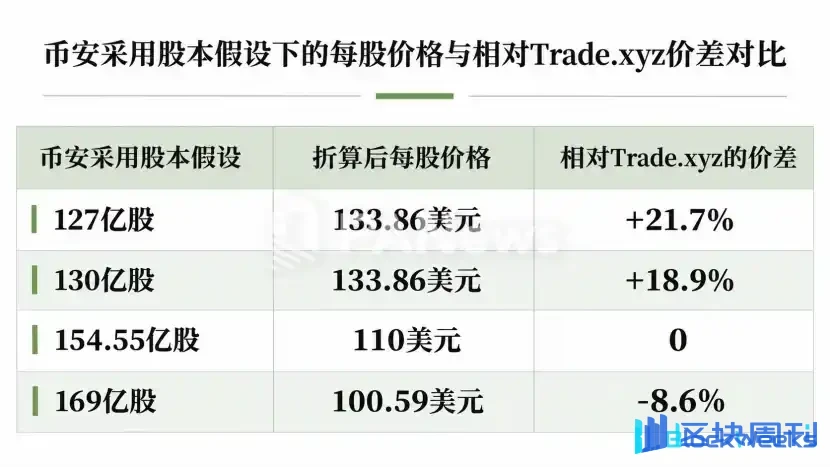
One group of traders believed that the exchange would adopt the "issued common shares" basis, that is, the number of shares actually outstanding after the IPO is completed, without counting all unexercised options and unvested restricted stock. Under this basis, the market generally estimated at the time that Anthropic's post-IPO share count would be about 12.7 billion shares.
The other camp remained cautious. Anthropic's equity structure is far more complex than that of an ordinary company, with employee options, restricted stock, convertible bonds, special class shares, and other layers nested within each other. If the exchange adopted a "fully diluted share count" basis, the total could approach 16.9 billion shares.
A gap of 4.2 billion shares is enough to determine whether a trade profits or loses.
Based on Binance's market price of $1,700 at the time, if 12.7 billion shares were used, a combination of going long xyz and short Binance could yield more than 20% profit; if 16.9 billion shares were used, the same operation would instead lose 8.6%; the break-even point was around 15.455 billion shares.

In other words, what the two sides disagreed on was how the exchange would interpret an Anthropic listing document that had not yet been finalized.
The camp supporting "issued shares" cited the SpaceX precedent. Arbitrage trader Silicon-based Bird Ray pointed out that when SpaceX listed in June this year, both Binance and OKX made adjustments based on the issued share count disclosed in the prospectus, without including all options and unvested shares. He also broke down Anthropic's preferred stock conversion, issued common shares, public welfare fund shares, convertible bonds, IPO new shares, and other items one by one, and the result he calculated also landed near 12.7 billion shares.
Cautious trader Psyche warned that SpaceX was only a single example, and that exchanges have final discretion over the rules. In particular, the convertible bond terms leave some room for flexibility, enough to affect the final number of shares counted. More importantly, "issued shares" is not the same thing as what the market commonly calls "free float"; locked-up shares and non-listed class shares could all be included in the calculation.
It was not until November 10 that the market reached a key turning point.
The Prospectus Reveals Its Hand: The 12.7 Billion Share Guess Eventually Became 13.1 Billion Shares
That day, the shoe finally dropped on the share basis question.
Anthropic submitted a second amended version of its S-1/A prospectus to the U.S. SEC, disclosing core IPO data for the first time: the company plans to issue 825 million Class A common shares at a price of $70-78.
It explicitly stated that after completing the IPO and concurrent private placement, Anthropic's issued share count is expected to be approximately 13.087 billion shares.
The next day, OKX was the first to follow up, announcing an IPO reference share count of approximately 13.116 billion shares. On the basis of the prospectus figure, it included a small number of additional shares from subsequent acquisitions and public welfare matching shares, while excluding all unexercised options, unsettled RSUs (restricted stock units), and reserved shares not yet issued, which to a certain extent confirmed the market's judgment on the "issued shares" basis.
On November 12, OKX officially executed a Rebase adjustment with a ratio of 1.3116 on the Anthropic Pre-IPO perpetual contract, while Binance's share parameter update and adjustment had not yet been officially announced.
As the key rules gradually became clear, the unease weighing on arbitrageurs gradually disappeared, and the increase in certainty began to be reflected in prices.
The Arbitrage Window Is Essentially Closed
As the rules became clearer, the spread also narrowed at a visibly rapid pace.
As of November 13, after conversion to a unified per-share basis, quotes across Binance, OKX, Hyperliquid, and other exchanges had all converged into the $102-104 range. The spread that once exceeded 20% now stood at only about 1%.

Clearly, the nature of Anthropic cross-exchange arbitrage has changed: the margin for error has shrunk significantly, while profits are negligible, and the risk-reward ratio for entering at this point has reversed dramatically.
In addition, funding rates, trading fees, margin occupation costs, and other factors are also "hidden killers" of profits.
This is the cruel nature of the crypto market: the most profitable opportunities usually belong to the few who are the first to understand the rules and dare to bet amid uncertainty. By the time most people notice, it is no longer an opportunity.
This arbitrage around Anthropic's Pre-IPO perpetual contracts is also a "cognition lesson" about market pricing mechanisms.
As more and more unlisted unicorns are packaged into Pre-IPO perpetual contracts, the pricing game is spreading from investment banks' roadshow rooms to the 24/7 uninterrupted crypto market.
Most people are accustomed to staring at candlestick charts and guessing whether prices will rise or fall; only a few will dig through contract terms, calculate share capital bases, and study exchanges' historical handling rules—but excess returns are hidden in these details that no one is willing to spend time scrutinizing.