
Author: Nancy, PANews
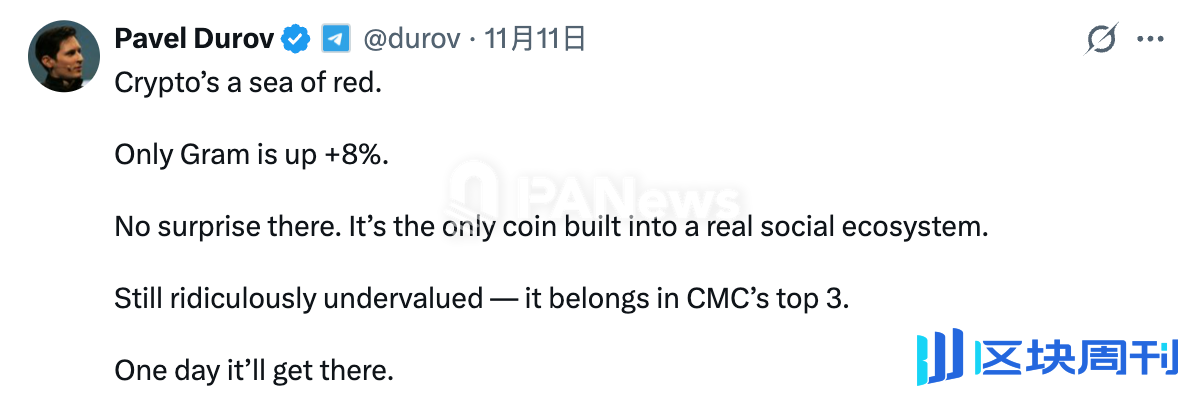
Recently, the crypto market has been in a slump, yet GRAM (TON) has bucked the trend and become one of the few tokens to rise. Telegram CEO Pavel Durov seized the moment to speak out, claiming that GRAM's market cap is "severely undervalued."
However, can the founder's optimistic expectations win market recognition? And does GRAM possess the ecosystem strength to support a high valuation?
Durov Boldly Claims GRAM Will Enter the Top Three, Yet the Price Can Hardly Hide Its Decline
Affected by factors such as rising hawkish macroeconomic expectations, sell-offs in tech stocks, continued ETF fund outflows, and intensifying geopolitical risks, the crypto market has generally declined recently, with market sentiment mired in fear.
However, GRAM has charted an independent course, not following the broader market decline but rising against the trend. CoinGecko data shows that GRAM is one of the hot tokens that have received more attention in the past 24 hours, and also the second-largest gainer among the top 100 tokens by market cap. Although the gain is only 5.3%, it has shown a certain degree of resilience amid a broad market decline.
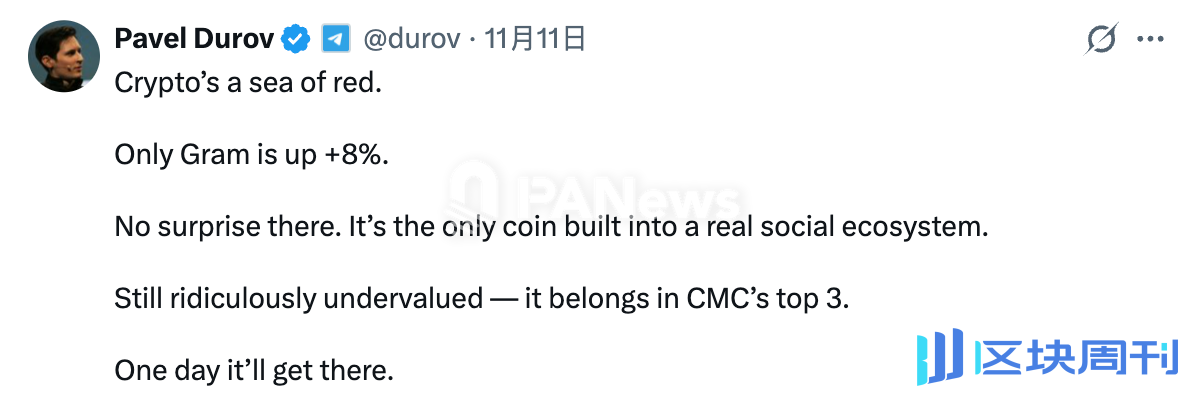
Durov subsequently publicly expressed his optimism about GRAM. He believes that GRAM is the only cryptocurrency truly integrated into a large social ecosystem, that its current market cap is still severely undervalued, that it deserves to rank among the top three in crypto market cap, and that he believes this goal can be achieved in the future.
In addition to publicly speaking out, Durov also updated his personal bio on X, adding the identity tag "Founder of TON Blockchain (2019)," further demonstrating to the outside world his determination to bet on the TON ecosystem again.
As the founder of the globally renowned instant messaging platform Telegram, Durov's public remarks quickly brought more market attention to GRAM and also boosted market sentiment to a certain extent.
In fact, TON (Telegram Open Network) was initially launched under Telegram's leadership, and its native token was named GRAM. However, due to U.S. regulatory litigation, Telegram was ultimately forced to withdraw from the project, and TON was subsequently taken over by independent developers and the TON Foundation, with the native token also renamed Toncoin (TON). For a considerable period thereafter, Durov publicly emphasized that he had no direct relationship with the project.
It was not until May of this year that Durov announced he was taking over TON again and changed the token name back to GRAM, becoming the main driving force and largest validator of the L1 network. To promote TON's deep integration into the Telegram ecosystem and make it the native payment and application infrastructure, Durov also launched a seven-step strategic plan called "Make TON Great Again (MTGA)."
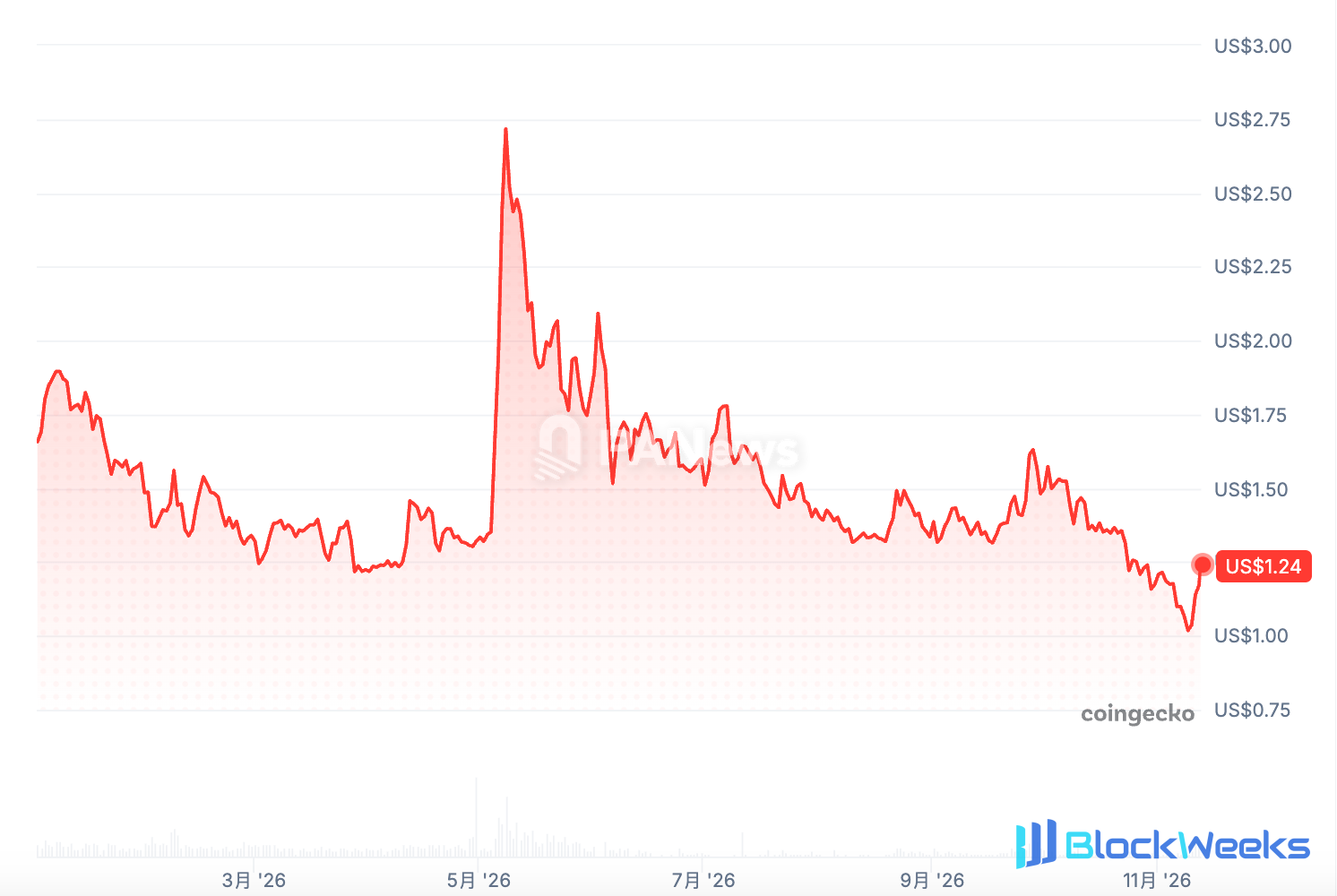
However, judging from the price performance, GRAM has not continued to strengthen as the strategy progressed, but after a short-term rebound entered a downward channel again. CoinGecko data shows that since hitting a high of $2.7 in May, GRAM has fallen about 55.1%; compared with its all-time high, the decline has reached 85.3%.
Behind the Wallet Surge Is Insufficient Adoption; Telegram Traffic Cannot Hide Ecosystem Shortcomings
In addition to GRAM's counter-trend performance, Durov also released the latest ecosystem-level data, trying to further prove its growth potential.
According to Durov's disclosure, self-custodial Gram wallets on Telegram have recently seen large-scale activation, which the market views as a positive signal of increased ecosystem adoption and which further boosted bullish expectations for GRAM.
The Gram wallet is a native self-custodial crypto wallet launched by Telegram in July 2026. Thanks to being directly embedded in Telegram, which has more than 1 billion users, the wallet was once regarded as one of the largest self-custodial wallet promotion attempts in the crypto industry.The wallet was initially opened to some invited users and, starting October 9, gradually opened to Telegram users worldwide.
Unlike traditional crypto wallets that require downloading an app, creating an account, and setting up a mnemonic phrase, the Gram wallet introduced an automatic activation mechanism.Users do not need to actively register or perform complex settings; as long as a Telegram account receives GRAM sent by someone else (even just 0.1 token), the wallet will automatically activate and appear in the Telegram settings interface. This design turns the transfer itself into a wallet activation entry point, greatly lowering the user threshold.
With the expansion of the wallet's open scope and the low-threshold activation mechanism, the number of Gram wallets has grown rapidly recently. GRAM Explorer data shows that as of November 12, the number of Telegram self-custodial Gram wallets had exceeded 3.53 million, with nearly 650,000 new ones added in the past 48 hours alone.

However, the rapid growth in wallet activations does not mean that the real adoption rate has increased in tandem. From the perspective of on-chain activity, GRAM Explorer data shows that as of November 12, Gram wallets had about 53,000 daily active addresses and about 66,000 transactions. Compared with the total number of wallets, daily active addresses account for only about 1.5%, and a large number of wallets have not yet become truly active.
At the same time, wallet addresses actually holding a GRAM balance number only about 188,000, collectively holding about 1.683 million GRAM, worth about $2.053 million at current prices. The actual number of holding addresses and their holdings are relatively limited.
Although Telegram's massive user base does provide GRAM with a traffic entry point that is difficult to replicate, whether that traffic can be further converted into real on-chain activity, long-term holding demand, and sustained economic value remains to be verified.
Beyond user conversion, the TON blockchain's own ecosystem development also faces challenges. At present, Telegram carries almost the main user entry point and application distribution channel of the TON ecosystem. Although this deep binding helps quickly bring in users and lower the customer acquisition threshold for applications, it also makes TON's development heavily dependent on Telegram and has not yet independently established a diversified ecosystem.
DeFillama data shows that as of November 12, TON's TVL was only about $45.74 million, far from its historical peak of about $780 million, and liquidity is mainly concentrated in two applications, Tonstakers and Stakee. Overall, the TON ecosystem still lacks sufficiently rich application scenarios and sustained capital inflows, and has not yet formed a large-scale, sustainable on-chain economy. At the same time, a relatively high development threshold also limits developers' entry to a certain extent, which is not conducive to the diversified development of ecosystem applications.

In terms of tokenomics, GRAM likewise faces a certain inflationary pressure. In April of this year, after the TON team implemented an accelerated block production upgrade, the generation speed of new blocks increased to 5 to 6 times the original, and the output speed of block rewards also accelerated accordingly, pushing the token's annual inflation rate up from about 0.6% previously to about 4%. As newly minted tokens brought by validator rewards continue to enter the market, the supply pressure facing GRAM has further increased.
It is undeniable that Telegram provides TON with a traffic gateway that other public chains find hard to match, and Durov's re-entry has also injected new development momentum into the ecosystem. However, from traffic introduction to real adoption, and from ecosystem expansion to value capture, TON still has quite a few hurdles to cross. Durov may have already outlined the vision, but ultimately it still needs ecosystem development and market performance to prove it.