

Pi Network price has slipped below $0.08 ahead of its Oct. 16 Protocol 28 mainnet upgrade, with daily momentum weakening and the 4-hour trend still pointing lower.
Summary
- PI traded at $0.07894, down 1.55% on the daily TradingView chart on Oct. 14.
- Daily RSI stood at 35.51, below its signal average and the neutral 50 level.
- The 4-hour Supertrend remained bearish, with its resistance line positioned at $0.08300.
- Pi Network scheduled Protocol 28 for Oct. 16 after an Oct. 13 node upgrade deadline.
TradingView’s OKX PI/USDT daily chart showed PI at $0.07894 on Oct. 14, compared with a daily opening price of $0.08025. The token traded between $0.07808 and $0.08094, placing it near the lower end of that range as the network approached its next scheduled upgrade.
The daily and 4-hour charts both showed PI below nearby trend indicators. On the daily timeframe, price remained beneath the Bollinger Bands’ middle line, while the 4-hour Supertrend stayed above the market following the latest decline.
Pi Network price approaches the lower Bollinger Band
TradingView’s daily chart placed the Bollinger Bands’ middle line, a 20-day simple moving average, at $0.08607. The upper band stood at $0.09526 and the lower band at $0.07687.
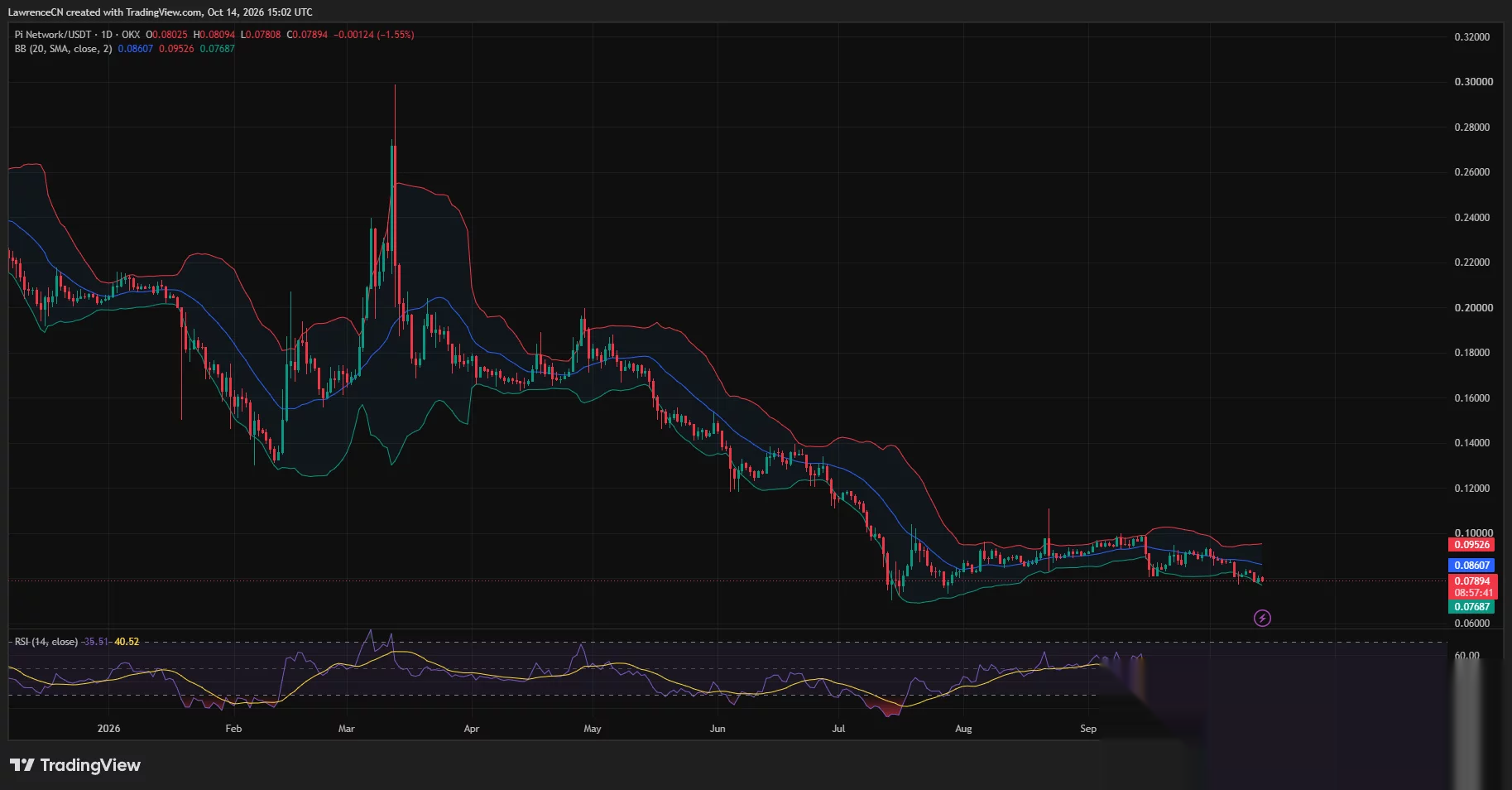
At $0.07894, PI was approximately 8.3% below the middle line and only 2.6% above the lower band. The positioning put the token much closer to the bottom of its recent volatility range than to its average price.
The daily chart also showed that the recovery from July’s lows had lost ground. PI climbed toward $0.10 during September before falling sharply in the middle of the month, briefly stabilizing and then retreating again in October.
Across the broader chart, successive rallies failed to recover the price levels seen earlier in the year. The latest move returned PI toward the lower portion of the trading range established after July’s sell-off.
The daily RSI registered 35.51, compared with its signal average of 40.52. Both readings were below 50, while RSI remained above the conventional oversold threshold of 30.
Taken together, the daily chart’s below-average price and sub-50 RSI support a bearish technical reading. The indicator had not reached an oversold level that would, by itself, distinguish the latest decline from the wider downtrend.
The 4-hour rebound stalls below $0.083
TradingView’s 4-hour chart showed a bearish Supertrend line at $0.08300, approximately 5.1% above PI’s $0.07894 price.
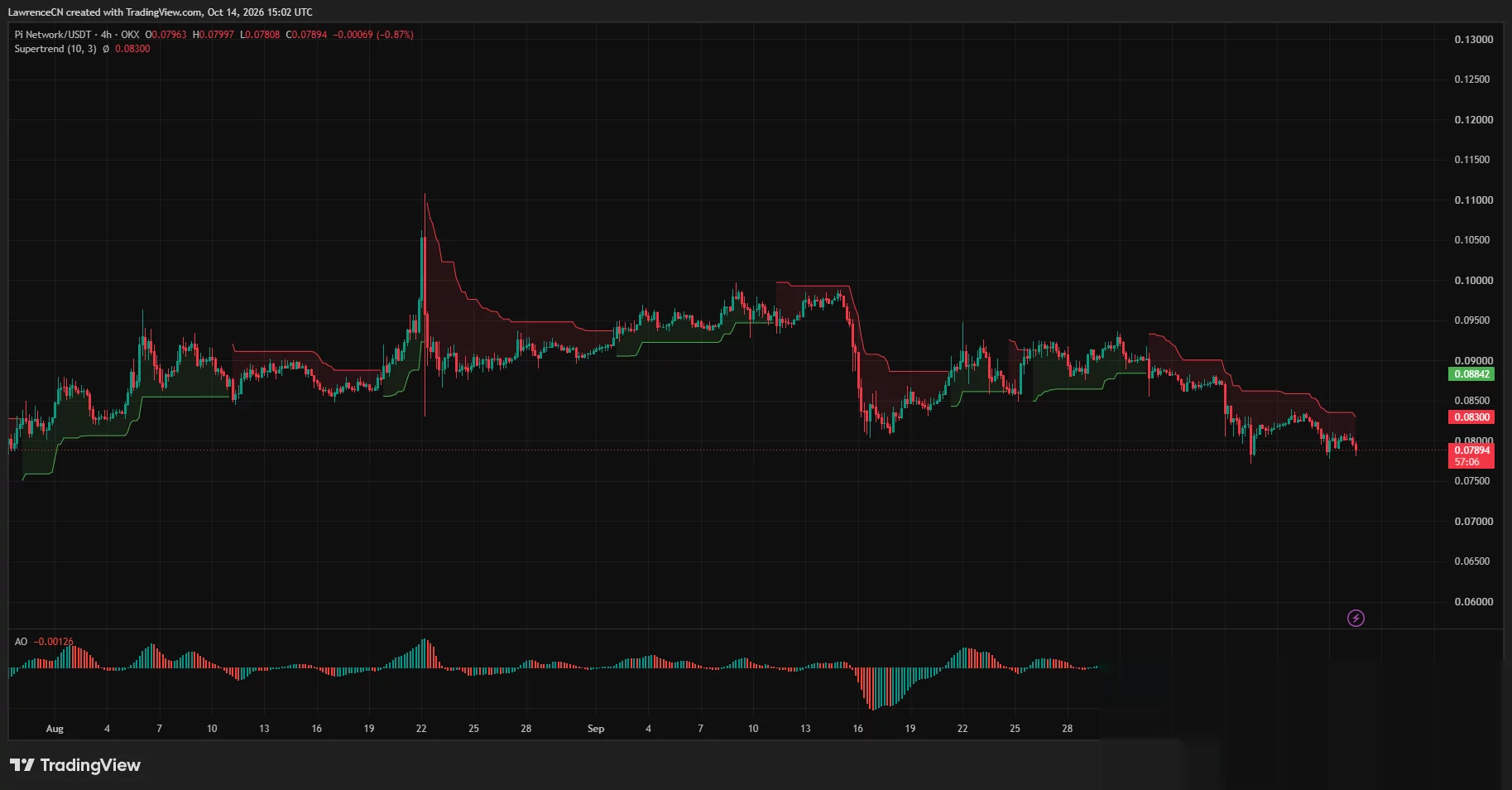
The shorter timeframe traced a decline from around $0.093 at the start of October. PI dropped toward $0.08 around Oct. 8, recovered briefly toward $0.083, and then gave back that rebound.
The latest price sequence therefore remained below both the early-October trading range and the Supertrend resistance line. A recovery through $0.08 would restore a round-number level, but the chart places the next trend barrier higher, at $0.083.
The Awesome Oscillator stood at negative 0.00126. Its histogram had contracted compared with the deeper negative readings around the October sell-off, but it remained below zero.
That combination shows a smaller negative momentum reading without a positive crossover. On the 4-hour chart, the reduced histogram size had accompanied sideways trading near the lows rather than a sustained move above resistance.
The daily low of $0.07808 provides the nearest price reference beneath the market. Below that, the daily lower Bollinger Band at $0.07687 marks the next visible indicator level.
For a recovery scenario, the charts place $0.08000 and $0.08300 ahead of the daily middle band at $0.08607. A move through the first level alone would leave PI beneath both the 4-hour Supertrend and its 20-day average.
Protocol 28 reaches mainnet on Oct. 16
Pi Network announced that its testnet had upgraded to Protocol 28 following the completion of Protocol 27 on mainnet.
According to the announcement, Protocol 28 improves the handling of delayed transaction data. It also allows developers to upgrade groups of smart contracts together and change stored application data more safely.
The network set Oct. 13 as the deadline for node operators to upgrade, ahead of the Oct. 16 mainnet rollout. Its official node page also states that every mainnet node must move to version 28.
The planned rollout arrives while PI remains below its daily average and 4-hour trend resistance. The announcement establishes a network event on the calendar, rather than evidence that upgrade concerns caused the price decline.
OUSD plans remain focused on future integration
Pi Network’s Oct. 8 stablecoin statement said its partnership with Open Standard would explore Pioneer rewards programs and broader uses for Open USD, or OUSD, within the ecosystem.
The project described OUSD as governed by a consortium of more than 200 companies, with a model designed to return most reserve income to distribution partners.
In its statement, Pi linked stablecoin use to predictable pricing, accounting and settlement, including transactions with parties outside a blockchain ecosystem. The dollar-based initiative gives U.S. holders a separate development to track alongside the native token’s price.
Pi said its current focus was establishing principles for future stablecoin integration, with compliance forming part of that work. It also said PI should remain the ecosystem’s primary cryptocurrency, while stablecoins serve a complementary role.
On the price charts, the immediate recovery thresholds remain $0.08300 on the 4-hour timeframe and $0.08607 on the daily timeframe. Below the market, $0.07808 and $0.07687 define the nearest visible downside references as the Oct. 16 upgrade approaches.