

Stellar (XLM) is trading at $0.1684, and the daily chart looks vulnerable. The price fell from the October high close of $0.2370 and now sits near the bottom level of recent weeks. Sellers still have control, and the trend line signals are adding more pressure.
Key signal for a price dive
The main warning is the death cross. This happens when a shorter moving average drops below a longer one, and it often points to more downside. On the XLM chart, the 50-day average has crossed beneath the 100-day average and is now moving toward the 200-day line at approximately $0.19. Both crosses lining up is why the signal is called a double confirmation. All three lines are now above the price, so each could act as resistance if XLM attempts to bounce.
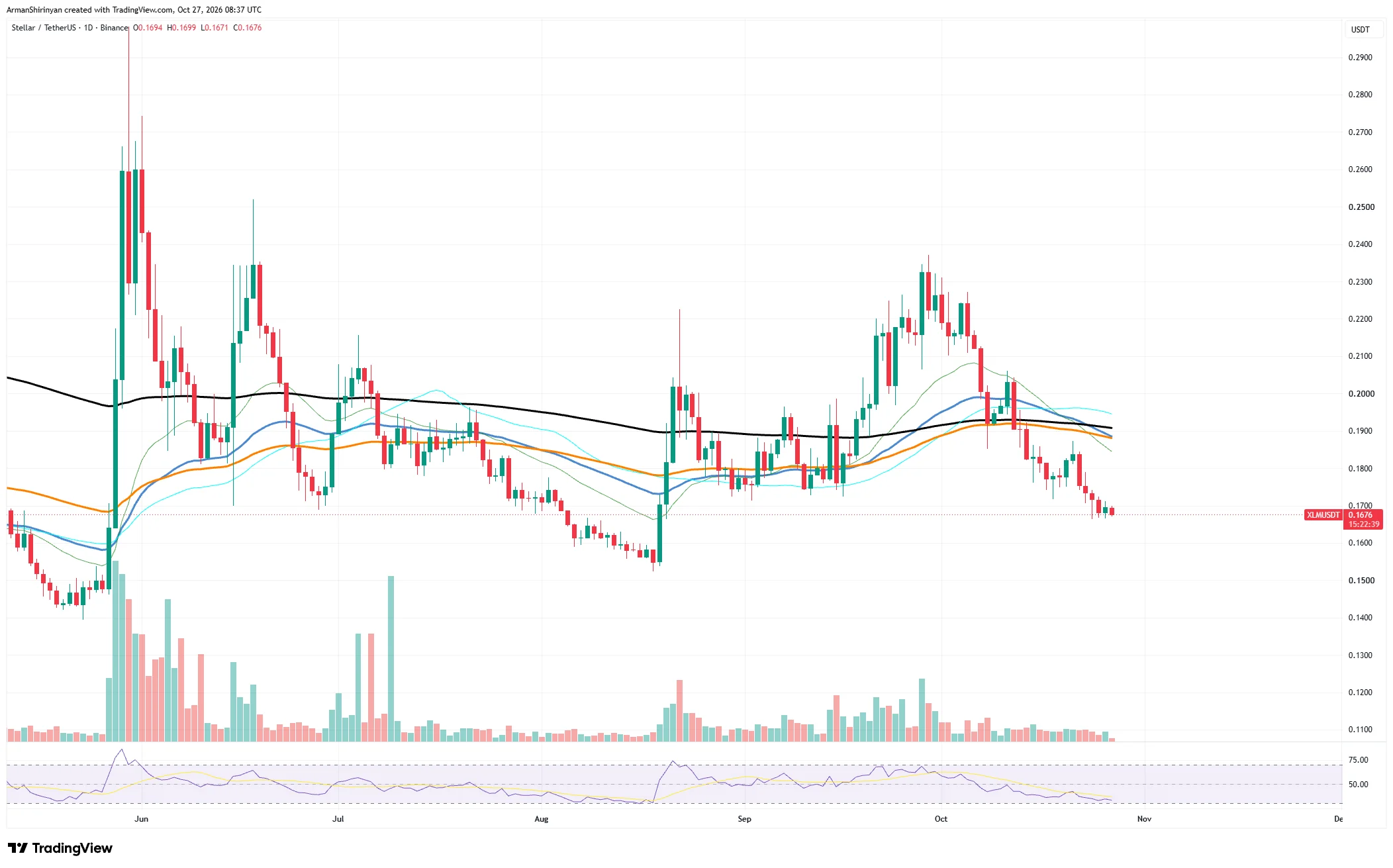
The moving averages are not the only problem. XLM lost the $0.19 and $0.18 zones in October without much of a fight. Each small recovery attempt failed at a lower level than the last one. The most recent bounce stopped near $0.187 and rolled over quickly. That pattern suggests buyers are not stepping in with strength.
The market is fading
Volume tells the same story. Trading activity has been fading during the drop, which means few buyers are rushing to buy the dip. Low volume during a decline can suggest the market is tired, but it can also mean there is no real demand to push the price up. The RSI is near 40, which is weak but not yet oversold. This leaves room for the price to fall further before a natural bounce appears.
Still, there is another support level available. The $0.15 area has held before. In August, XLM dropped near this level and buyers pushed the price sharply higher, leading to a rally above $0.22. This makes $0.15 the next key area to watch. It sits approximately 11% below the current price. If XLM breaks beneath the recent low near $0.167, a move toward $0.15 becomes likely. A strong response there could start a recovery. If $0.15 fails, the next stop is the $0.14 area, where the price traded in May.
For bulls, the primary goal is to climb back above $0.18. Only a move above the 200-day average near $0.19 would cancel the bearish setup. Until then, caution makes sense.