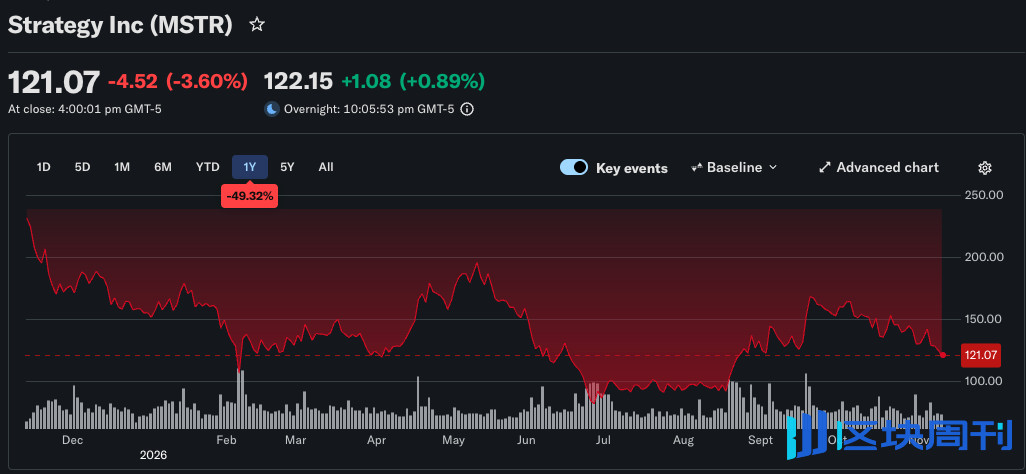

Strategy has faced renewed pressure ahead of MSCI’s November 11 index review, with its possible removal from major equity benchmarks threatening to trigger billions of dollars in institutional share sales.
Summary
- MSCI is scheduled to announce its November 11 index review, with Strategy facing potential removal under new eligibility rules for companies classified as nonoperating businesses.
- JPMorgan analysts previously estimated that Strategy’s exclusion could trigger roughly $2.8 billion in institutional selling, while around 13 million MSTR shares are held by funds tracking MSCI indexes.
- MSTR shares have fallen approximately 17% over the past two weeks, raising concerns about Strategy’s ability to raise capital through future stock offerings to finance Bitcoin purchases.
- Market commentator Adrian Morris believes much of the potential selling pressure may already be priced into MSTR shares and does not consider MSCI exclusion an existential threat to Strategy.
According to MSCI’s announcement, the index provider will publish its final list of additions and deletions shortly after 11 p.m. Central European Time on Wednesday. Any changes will take effect after the market closes on November 30.
The decision could affect Strategy, the world’s largest corporate Bitcoin holder, after MSCI adopted new eligibility rules in October that exclude companies classified as non-operating businesses.
JPMorgan analysts previously estimated that removing Strategy from MSCI indexes could trigger roughly $2.8 billion in selling by passive investment funds. The estimate was prepared under an earlier version of MSCI’s proposed rules.
Strategy’s shares have already fallen considerably ahead of the announcement. MSTR closed at $121.07 on November 10, down approximately 16.6% from $145.16 on October 28.
MSCI rules put Strategy’s index membership at risk
On October 15, MSCI approved new eligibility criteria intended to exclude companies whose financial characteristics resemble investment funds instead of operating businesses.
The methodology first examines whether a company has substantial operating assets. Companies that fail this initial screening face five additional financial tests covering their assets, expenses, operating cash flow, fair-value exposure and dependence on external financing.
An issuer can become ineligible if it fails at least four of those five tests. Existing index constituents must meet the exclusion conditions across their two most recent annual reporting periods, although MSCI can consider more recent interim filings.
As previously reported by crypto.news, the methodology places Strategy’s business model under scrutiny because a substantial portion of its balance sheet consists of Bitcoin holdings.
Strategy has acknowledged the risk in its financial disclosures and expects its common stock to be removed under the revised criteria.
The potential exclusions extend beyond Strategy. Japan’s Metaplanet and other companies with investment-heavy balance sheets have faced similar questions over their eligibility.
How much selling could MSCI removal trigger?
Strategy previously disclosed that investment funds tracking MSCI indexes held approximately 13 million MSTR shares, representing around 3.1% of its basic shares outstanding.
At Tuesday’s closing price, those holdings were worth approximately $1.57 billion. The figure represents the market value of the estimated shares held by index-tracking funds, not a confirmed amount of selling.
JPMorgan’s higher $2.8 billion estimate suggests a potentially larger impact, while previous analysis has raised the possibility of further outflows if other major index providers adopt comparable restrictions.
Passive funds tracking affected benchmarks would need to adjust their holdings around the November 30 implementation date. The actual selling pressure would depend on fund exposure, trading activity and how investors position themselves before the changes take effect.
Market commentator Adrian Morris, however, believes investors may have already accounted for much of the potential impact.
In a November 11 post on X, Morris said an official exclusion announcement could cause another decline in Strategy’s shares, but argued that the event would not necessarily threaten the company’s survival.
“If | when a de-listing happens, we may see a drop after an official announcement. But likely priced in, not a terminal event,” he wrote.
Morris had previously challenged the characterization of the estimated $2.8 billion outflow as an existential threat to Strategy in an October 16 post.
Strategy continues buying Bitcoin despite stock pressure
Strategy’s latest Bitcoin purchases have continued despite the decline in its common stock.
On November 9, the company disclosed that it had acquired another 1,036 BTC, bringing its total holdings to 850,364 BTC as of November 8.
The company simultaneously repurchased approximately $188.3 million of its STRC preferred shares, using proceeds from common stock sales to finance the transactions.
Strategy has relied on equity offerings and preferred securities to raise capital for Bitcoin purchases. A sustained decline in MSTR’s share price could make future common stock issuance less attractive, particularly when its market valuation approaches the value of its underlying Bitcoin holdings.
MSCI exclusion would not itself require Strategy to sell Bitcoin. The immediate effect would fall on investment funds holding MSTR shares, while any consequences for the company’s cryptocurrency purchases would depend on its future financing decisions.
According to Strategy’s November 9 disclosure it held approximately $4.9 billion in US dollar assets alongside its Bitcoin treasury.