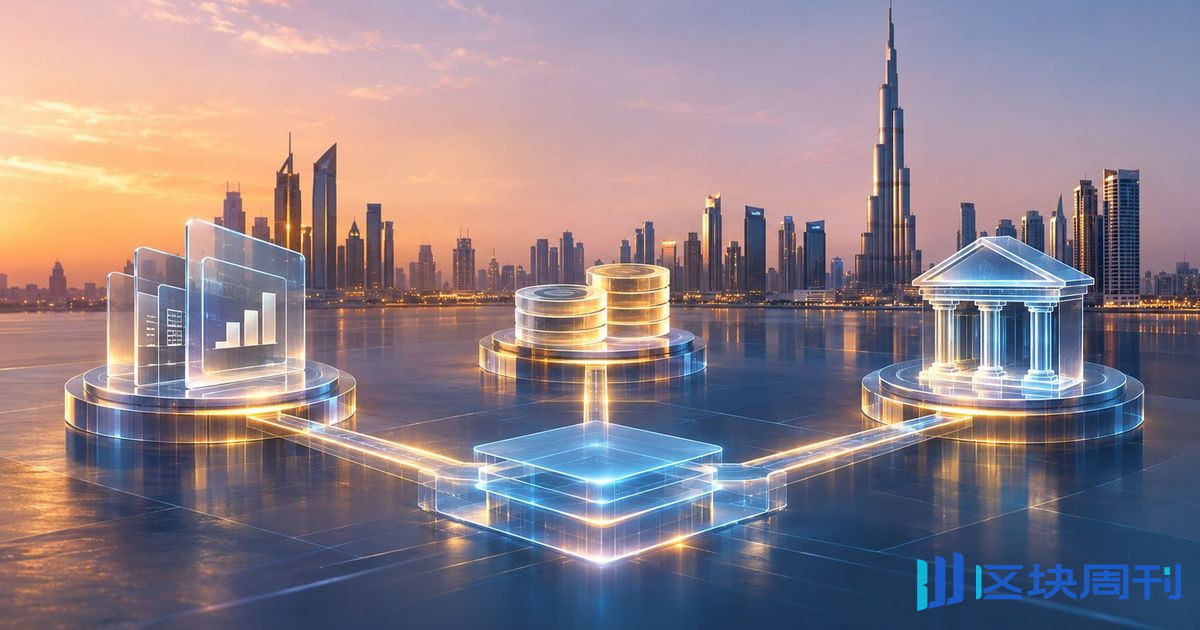
The UAE's tokenization process is entering a more difficult phase. The question is no longer "whether financial assets can be moved onto the blockchain," but whether, once these assets are truly on-chain, the various links of a financial transaction can operate in coordination.
Imagine an investor who wants to buy a tokenized bond or fund: the asset is issued on one chain, while the digital currency used for payment runs on another network, or even remains within the traditional banking system; at the same time, this investor already has a business relationship with a bank that handles customer identity verification, payment processing, and may provide custody and other services. For this transaction to be completed smoothly, the asset platform must recognize the payment, the settlement system must transfer the correct amount, and the bank must be able to verify the investor and support the transaction under clear legal and operational arrangements. All three must be connected.
This is precisely the next test for tokenization: moving from the digitization of a single asset toward a financial market in which assets, funds, and institutions can truly interact.
The Dubai Financial Services Authority (DFSA)'s newly released white paper, "Scaling Tokenization: The Road Ahead," systematically lays out the conditions required for this transformation. Based on structured interviews with BlackRock, Ripple, Robinhood, Standard Chartered, and Soter Insure, combined with regulatory and market research, the report points out that many challenges go far beyond "the technology of issuing tokens" itself.
Its conclusion points to a larger question: can the UAE transform its increasingly rich digital asset initiatives into interconnected financial infrastructure that banks, institutions, and investors can use across the full transaction lifecycle?
The Missing Link Between Assets and Funds
Tokenization allows financial assets to exist in blockchain form, theoretically enabling more flexible issuance, transfer, and settlement. But putting assets on-chain does not in itself amount to a functioning financial market.
Every purchase contains two sides of the same transaction: the transfer of the asset and the transfer of payment. In traditional markets, these two ends are supported by mature institutions, payment systems, and settlement arrangements; in tokenized markets, the asset and the funds used to purchase it may exist on entirely different infrastructures. Connecting them is not just about building a technical bridge; all parties must also agree on the payment method, when ownership transfers, which record is authoritative, and how problems are handled when they arise.
The DFSA identifies "the integration of tokenized assets and digital currency" as a key condition for scaling tokenized financial markets. Potential settlement instruments include regulated stablecoins, tokenized commercial bank deposits, and wholesale central bank money. The three provide different paths for "bringing funds on-chain": stablecoins can be transferred on public chains, tokenized deposits can allow commercial bank money to circulate on digital platforms, and wholesale central bank money provides another settlement paradigm for institutional markets.
The goal is not to create more forms of digital currency, but to ensure that the funds used in transactions are credible, accessible, and compatible with the infrastructure that handles the assets.
This is especially critical for atomic settlement—where the transfer of the asset and the corresponding payment occur simultaneously, reducing the risk that one party delivers the asset but does not receive the money. But the DFSA also cautions that liquidity, prefunding, and the role of netting and central clearing must be considered. If participants must lock up large amounts of funds to complete transactions, faster settlement does not automatically equal a more efficient market. The real challenge is to improve transactions without creating new operational or liquidity constraints.
Banks Are Not to Be Bypassed, but "Extended"
Even if tokenized markets develop, banks remain an important part of transactions. Investors may not be willing to give up their existing banking relationships just to buy a digital asset. Banks may still be the institution that knows the customer, performs identity checks, provides funding channels, and supports payments; depending on the arrangement, they may also provide custody or connect investors to regulated trading platforms.
This requires tokenized markets to have the ability to interoperate with "the institutions already serving investors."
The DFSA report highlights progress in migrating traditional bank money into blockchain environments. For example, JPMorgan has issued deposit tokens representing commercial bank deposits, and its JPMD token was made available to institutional clients on Coinbase's Base network in November 2025. The report also discusses the exploration of digital asset infrastructure and tokenized collateral by established financial institutions, including Standard Chartered.
These cases show that banks can extend their services into digital markets rather than operating in parallel with them. But connecting a bank to an on-chain transaction is far more than "letting money flow between systems": the bank must be able to confirm the identity of participants, understand the nature of the asset and payment, and determine how its responsibilities apply when a transaction spans multiple infrastructures.
Custody is another crucial aspect of this relationship. Holding a token does not necessarily equate to holding a security through a traditional custody arrangement. Institutions need clarity on the legal ownership of the asset, control of private keys, segregation of client assets, and how assets are handled in the event of a custodian's or service provider's insolvency.
The DFSA emphasizes that institutional-grade custody cannot stop at "protecting private keys"; it also requires reliable ownership records, reconciliation between on-chain and off-chain systems, governance arrangements, business continuity planning, and clear processes for corporate actions, protocol changes, and key recovery. These safeguards matter because the relationship between investors and banks does not end the moment an asset moves on-chain; responsibilities surrounding the asset must run through its entire lifecycle.
Different Financial Systems Must "Speak the Same Language"
Even if assets, payment instruments, and banks can each function, transactions will still fail if the underlying systems cannot communicate.
Tokenized assets are growing simultaneously on public chains, permissioned networks, and proprietary platforms owned by financial institutions, creating a fragmented environment: an asset issued on one network may not be smoothly accessible to investors, payment service providers, or custodians elsewhere. The DFSA calls this risk "digital islands." If these environments remain isolated from one another, tokenization may instead replicate the fragmentation it was meant to eliminate, leaving institutions struggling across multiple systems with limited compatibility.
Technical interoperability is only part of the equation. Standards such as ISO 20022, unified token formats, APIs, and secure communication protocols can help different systems exchange information and instructions. But the DFSA makes clear that interoperability also includes operational, legal, and regulatory dimensions.
For example, a token may represent the asset itself, may be the authoritative record of ownership, or may merely be a contractual right pointing to an asset registered off-chain. If the off-chain register remains the legally authoritative record, on-chain transactions must be reconciled with it; parties must also clarify when settlement is final, whether transactions can be reversed, and how disputes or operational failures are handled. These issues become further complicated when transactions involve institutions in different jurisdictions—a transfer that technically works across two chains is still insufficient if the legal rights attached to the asset cannot be consistently recognized.
The UAE's Opportunity: Connecting the Entire Transaction
This is precisely where the UAE's opportunity lies. The country has attracted a large number of digital asset firms, established regulatory frameworks, and encouraged traditional financial institutions to interact with blockchain companies. But the next stage will not be measured merely by how many tokenized products have been issued or how many platforms are on the market, but by whether these different participants can work together to support a complete financial transaction.
Within the Dubai International Financial Centre (DIFC), the Digital Economy Court established in 2021 and the Digital Assets Law introduced in 2024 form part of the legal foundation identified in the DFSA report. The report also notes that DIFC's international financial community is expected to become a platform bringing together institutions, technology providers, investors, regulators, and standard setters.
This "convener" role is especially important because no single institution can build an interconnected tokenized market on its own: asset issuers need platforms to create and distribute products, investors need familiar and reliable access channels, banks need to connect customer relationships and payment services to digital asset infrastructure, custodians must protect holdings and maintain reliable records, and digital currency providers need settlement instruments that can interact with asset trading networks. The UAE's challenge is to create an environment in which these participants can act in coordination under clear legal, regulatory, and operational expectations.
This also means looking beyond borders. Tokenized markets are likely to involve assets, investors, and service providers operating across borders. The DFSA acknowledges that achieving detailed regulatory harmonization in the short term is not easy, but greater consistency in legal, operational, and technical standards can reduce fragmentation and make cross-border participation more predictable. For an international financial centre, the ability to connect different systems and jurisdictions may be as important as the ability to attract new digital asset firms.
The Commercial Test: Will Investors Actually Use It?
There is also a problem that cannot be solved by infrastructure: demand.
Even if a tokenized asset is technically sound, has a clear legal structure, and is supported by banks, it still needs investors, trading activity, and sufficient liquidity to become a viable market.
The DFSA calls this the "cold start" problem. Traditional financial markets already have mature participants, settlement processes, and infrastructure, and a single institution lacks the incentive to migrate to a new system—unless the new system offers measurable benefits and enough other participants are already prepared to use it. This is precisely why "connecting assets, funds, and banks" is as important commercially as it is technically: if investors cannot access tokenized products through familiar financial relationships, if payments require cumbersome transfers across multiple networks, and if assets are difficult to trade across platforms, the potential efficiency gains will remain limited.
Network effects are crucial. Issuers, investors, banks, custodians, trading venues and settlement service providers need to grow together; as participation rises, the value of the market to each party increases. Without participation, even the most advanced technology platform may become an isolated project. DFSA's analysis also suggests that the market must strike a balance between faster, more flexible settlement and the liquidity needs of participants: while round-the-clock infrastructure has advantages, it must be weighed against the funds required for trading, as well as the existing efficiencies of netting and central clearing.
Ultimately, institutions will only adopt tokenization at scale when it makes financial activity more accessible, more efficient or more commercially attractive.
From "interconnected infrastructure" to "usable markets"
This white paper does not prescribe a particular technology, regulatory or business model, but rather examines which conditions can support responsible growth, while acknowledging that the market remains fragmented and that different institutions and jurisdictions may take different paths.
The report also warns that greater connectivity brings new risks. As tokenized markets become more closely linked with traditional finance, dependencies among custodians, settlement service providers, smart contracts, cloud services and blockchain cross-chain bridges may create new channels for operational disruption or financial stress transmission. The report believes that at current scale, the industry is not yet likely to pose a material financial stability risk, but as tokenization becomes more interconnected and widely used for trading, settlement, collateral and financing, its impact could expand.
For the UAE, this means the next phase goes far beyond "putting assets on-chain" to ensuring that the entire transaction works: can investors buy tokenized products through accessible and trusted financial channels? Can the bank serving that investor connect to the asset issuance platform? Even if the asset and the settlement instrument are on different networks, can payment be completed using reliable digital money? Can ownership be confirmed, custody maintained, and settlement recognized under clear legal arrangements?
These questions will determine whether tokenization can move from isolated projects to a truly functioning financial market. The UAE has an opportunity to help shape this connection by bringing together the required institutions, infrastructure providers and regulatory frameworks. The real test is whether investors can move seamlessly between assets, funds and banks without being blocked by the boundaries between their respective systems.
The next breakthrough in tokenization may not be another digital asset, but rather making the financial system surrounding that asset truly integrated.