Machine Heart Editorial Team
Finally, in the race over who would release the new generation of flagship models first, Anthropic made the first move.
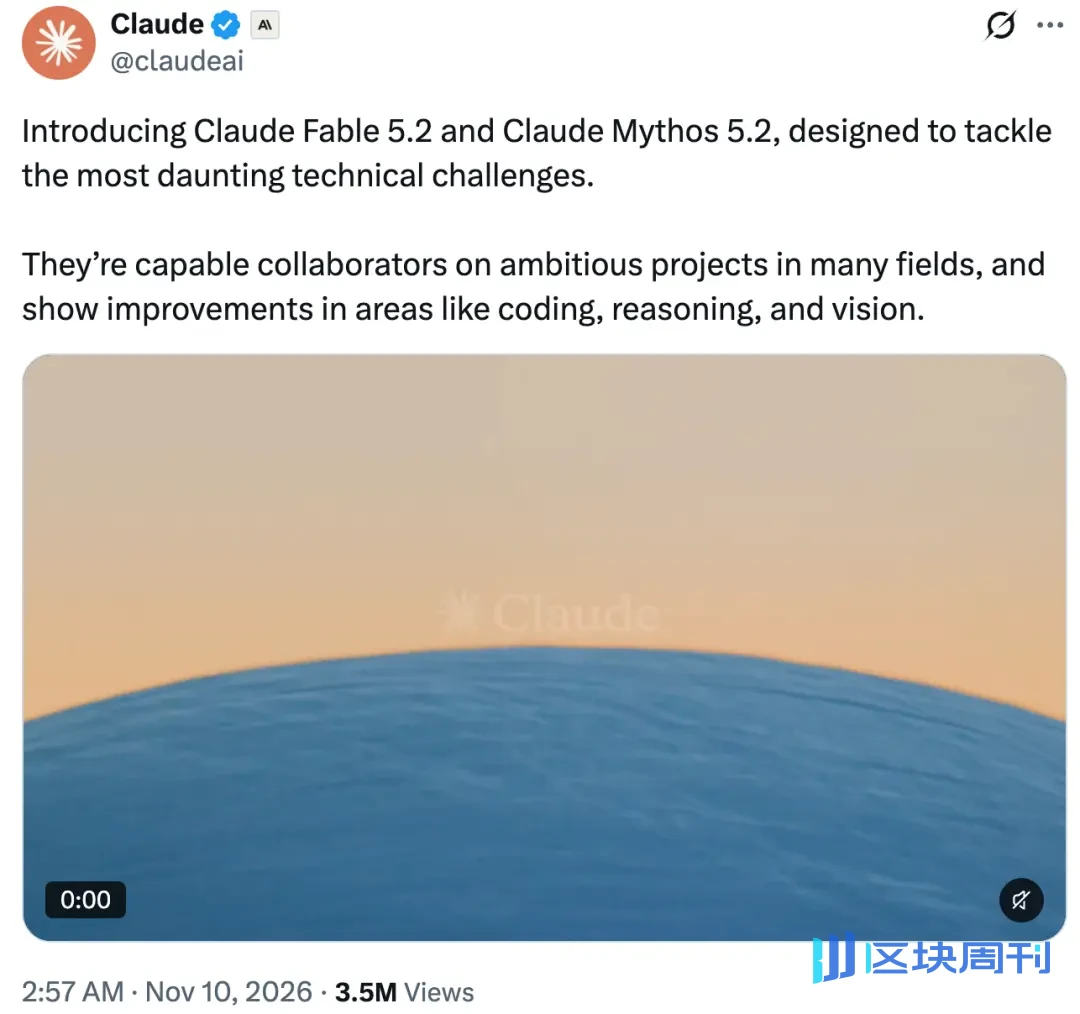
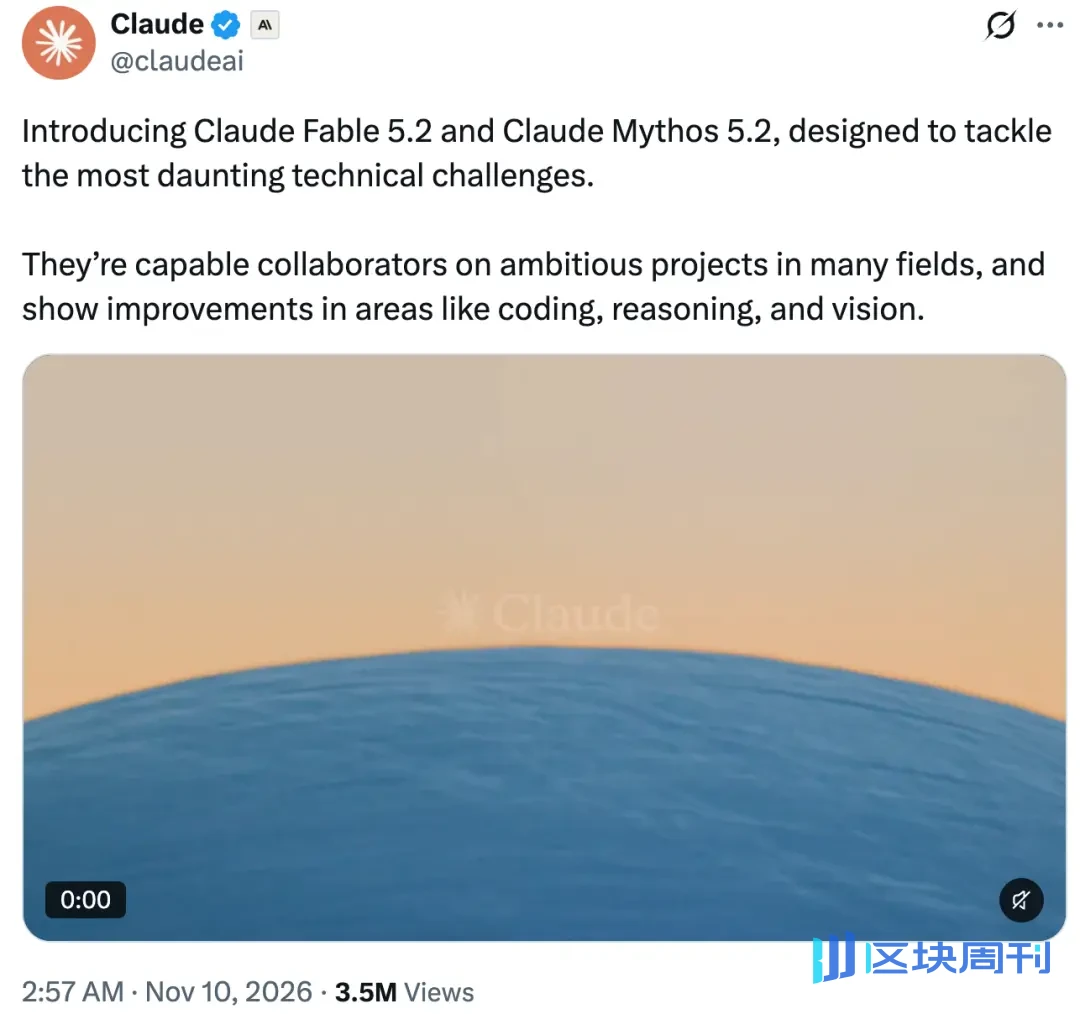
In the early hours of today, Anthropic released two top-tier models in one go: Fable 5.2 and Mythos 5.2 took the stage.
The company officially claims that "both models target highly difficult technical challenges, are able to participate in large, complex projects across multiple domains, and achieve further improvements in areas such as coding, reasoning, and vision."
In addition, Anthropic has also started playing the "Reset" perk familiar from OpenAI's Tibo.
The father of Claude Code also announced, "We want to provide more benefits to the users who have been with us the longest. Therefore, in Fable 5.2, the longer the subscription period, the more Fable resets users receive."

According to the introduction, in tests before their official release, Claude Fable 5.2 and Claude Mythos 5.2 helped Anthropic's engineers complete software migration projects that had previously been difficult to achieve, design three electronic devices that can operate properly from scratch, solve two unresolved problems in the field of black hole physics, make major progress in robotics evaluations, and complete a formal proof of Fermat's Last Theorem in just 30 hours. In addition, they have many other application scenarios.
Claude Fable and Claude Mythos use the same underlying model. Fable is equipped with strict cybersecurity and biosecurity safeguards that can effectively prevent model misuse, and therefore can be opened to all users. For institutions that wish to use the model in beneficial fields such as cybersecurity or biomedical research, they can apply for access to Mythos through Anthropic's recently expanded life sciences program and cybersecurity verification program.
The two models generate up to 30% faster than Claude Fable 5.1 and Claude Mythos 5.1, and their prices have also been reduced: $8 per million input tokens and $40 per million output tokens.
Fable 5.2 and Mythos 5.2 also offer an optional Fast Mode, which can increase token generation speed by up to 2.5 times. Fast Mode is priced at $16 per million input tokens and $80 per million output tokens.
Evaluation performance of Claude Fable 5.2 and Mythos 5.2
Benchmark results
The benchmark results below show that on almost all capabilities evaluated by Anthropic, Claude Fable 5.2 and Mythos 5.2 outperform Opus 5.5.
From the cross-comparison evaluations, Fable 5.2 takes the lead on multiple complex tasks. In coding, it scored 49.1% and 69.9% on FrontierCode 2.0 and FrontierSWE v2, respectively, surpassing GPT-6 Astra's 42.8% and 65.5%, and also leading Opus 5.5. In the RoboDojo Sim robotics manipulation evaluation, Fable 5.2 reached 64.9%, an increase of 37.3 percentage points compared with the previous generation Fable 5.1's 27.6%, and significantly higher than Opus 5.5's 39.4% and GPT-6 Astra's 29.8%.
In addition, it achieved 89.3% in the OSWorld 2.1 computer operation evaluation and 74.2% in the Humanity's Last Exam multidisciplinary reasoning evaluation (with tools), both ranking first among the models evaluated in the figure. However, in the AA-Briefcase knowledge work evaluation, Opus 5.5 slightly led with an Elo score of 1800, while Fable 5.2 scored 1785. Some of the high scores in scientific research and cybersecurity came from the concurrently released Mythos 5.2.

Reasoning intensity and efficiency
At the Medium reasoning intensity setting, which is also the default setting for the Claude app and Claude Code, Fable 5.2 requires fewer tokens than Fable 5.1 when completing challenging tasks.
In early tests of the FrontierCode 2.0 evaluation, when using High reasoning intensity, Fable 5.2 achieved results roughly comparable to Opus 5.5 using Max reasoning intensity, while the cost per task was only about half that of the latter. At the Xhigh reasoning intensity, Fable 5.2's results also surpassed all other released models participating in the test.

Coding
Currently, more than 90% of merged code changes in Anthropic's core codebase are completed by Claude under human guidance.
Anthropic has used Fable 5.2 to fix long-standing difficult bugs within minutes, optimize the operating performance of various services, and complete some important software projects that were originally difficult to start due to being too time-consuming or costly.
Previously, a team of agents powered by an early version of Fable 5.2 migrated a key production service from Python to Rust. After the migration, the operating efficiency and reliability of this service were improved, and its startup speed increased to about 26 times the original.
Tests also found that Fable 5.2 possesses strong engineering judgment. Even when faced with relatively vague requirements, it can deliver high-quality results.
In one experiment, an Anthropic engineer asked Fable 5.2 to design a prototype operating system from scratch. Starting from an empty folder, the model coordinated more than 1,000 sub-agents, writing, testing, and reviewing code continuously for 8 days without interruption. In the end, it successfully developed an operating system capable of booting and running on a laptop.
This system has its own kernel that can drive the entire machine; it includes disk, keyboard, and network drivers, as well as persistent file storage, a window system, a login interface, and an installer, and it also has Claude functionality built in.
Early testers were also impressed by how Fable 5.2 applied its programming capabilities to a wide variety of different tasks.
Cybersecurity
Claude Mythos 5.2 is Anthropic's model with the strongest cybersecurity engineering capabilities to date. Compared with previous models, it can discover more security vulnerabilities and is also better at reproducing and fixing them. It should be noted that Claude Fable 5.2's safety guardrails will block most cybersecurity-related tasks.
A cybersecurity company found that one-sixth of the vulnerabilities that Claude Mythos 5.2 found and confirmed had not been discovered by any of the other frontier models they tested.
In Anthropic's internal benchmark CVE Rediscovery, Claude Mythos 5.2 discovered 10.2% more vulnerabilities than Claude Opus 5.5 and 14.4% more than Claude Mythos 5.1.
Claude Mythos 5.2 also showed marked improvements in judgment accuracy and confidence calibration. One tester found that previous models exaggerated the severity of about 1 in every 20 vulnerability findings, while Claude Mythos 5.2 never did so.

Users can access Claude Mythos 5.2's cybersecurity capabilities through the Cybersecurity Verification Program. Anthropic is also continuing to expand and improve this program.
Even without joining the Cybersecurity Verification Program, Claude Enterprise customers can use Claude Security. This service uses Anthropic's most capable models to scan codebases for potential vulnerabilities, and it has now been integrated with Claude Mythos 5.2.
A recent update further enhanced Claude Security's capabilities. It can now continuously monitor code repositories, track code updates, and ensure that discovered vulnerabilities are fixed; it can also analyze with more contextual information and connect to other tools used by users through APIs and MCP.
Science and Engineering
Much of the important work in science, engineering, and mathematics is increasingly dependent on programming capabilities. Whether it is analyzing data, building molecular models, designing components, or controlling experimental instruments, all of this can be done through software.
Below, Anthropic describes how Claude Fable 5.2 and Claude Mythos 5.2 help researchers solve difficult problems in these fields and advance related research.
Theoretical Physics
Claude Fable 5.2 solved two unresolved problems in theoretical physics. Both problems are related to black holes and also involve the unification of the two foundational theories of modern physics—relativity and quantum mechanics.
Both achievements made by Claude are built on the theory of Holographic Duality. The core idea of this theory is that certain universes containing gravity can be precisely described by a quantum theory that contains no gravity at all.
The first problem dates back to 1983. At that time, physicists had already shown that as these universes continue to heat up, black holes suddenly form, just as water suddenly boils after being heated to a certain point.

Address: https://hexagonmath.org/2611.00175v1
However, the methods used at the time were only applicable to sufficiently large universes, because only at such scales does relativity apply. In 2003, researchers proposed a computational task to figure out whether the same phenomenon would also occur in very small universes. In these universes, only quantum theory can be used for description. However, this computation was too complex and time-consuming, and no one had been able to complete it.
Fable 5.2 essentially completed this computation autonomously and found that even in very small universes, this transition also occurs suddenly.
The second problem involves a technique that physicists have used for more than 15 years. This technique is used to rule out possible quantum gravity theories in simplified universe models. Fable 5.2 found the precise boundary of applicability for this technique.

Address: https://hexagonmath.org/2611.00174v1
Protein Folding
Adeno-associated Virus (AAV) is a very small virus that is harmless to humans. Its protein shell, known as the capsid, can be used to deliver gene therapies. The protein structure of the capsid is very important. For example, it affects whether the gene therapy will be recognized and blocked by the patient's immune system. But the structure of the capsid is also quite complex.
Existing protein folding models such as AlphaFold can predict the structure of a single protein, but a viral capsid is composed of dozens of proteins, and the overall structure is much more complex.
Building on two open-source protein folding models, Claude Mythos 5.2 found a new method that can accurately predict the structure of the entire capsid. Specifically, it wrote code to have the two models separately process groups of protein chains with overlapping regions, then used the known symmetry information of the capsid to integrate the prediction results of each part, ultimately reconstructing the complete capsid structure.
This method achieved good results on multiple natural and artificially designed capsids. In our tests, 28 of the 34 capsids that Claude attempted to model received accurate structure predictions.
Mathematics
Mathematical formalization refers to converting mathematical proofs into a language that computers can check step by step. This work can help mathematicians verify research results and increase confidence in the correctness of proofs without having to rely entirely on manual step-by-step checking. This is even more important when AI models produce results that are difficult for humans to verify directly.
But mathematical formalization is usually very time-consuming. If AI can assist with this work, mathematicians can devote more time to exploring new mathematical ideas.
Previously, Anthropic used an unreleased research version of Claude to formalize Fermat's Last Theorem, and the entire process took 11 days. This work relied on a specially designed execution framework (Harness) and also required guidance from human researchers.
By contrast, a team composed of 1,000 Fable 5.2 agents completed the formalization of the entire theorem in only 30 hours, with almost no human intervention during the process.

Starting from a very limited prompt, Fable 5.2 established a collaboration mechanism among agents on its own. Throughout the process, it did not use any mathematical reference materials, relying only on a list of intermediate theorem statements to assess task progress.
Compared with our first formalization effort, this task consumed only one-third of the action tokens, and the final proof length was reduced to one-seventh of the original.
The figure below shows the performance of different models: under the same configuration of 1,000 agents, Opus 5.5 spent 18 hours and completed only 26% of the formalization work. Even when run for 30 hours, progress barely increased.

Hardware and Robotics
Much of AI's potential value, such as accelerating laboratory research, depends on whether it can take action in the physical world. Claude Fable 5.2 continues the trend of the Claude series models becoming increasingly useful in the real world. In tasks such as hardware device design, it has already demonstrated solid capabilities, and it has also made significant progress in physical robot control.
Anthropic specifically tested Fable 5.2's hardware engineering capabilities, giving it only a brief prompt and asking it to design and build three working electronic devices. Each device needed its own circuit board, 3D-printed enclosure, and supporting software. The three completed devices were: a home voice assistant hub, a USB speakerphone, and a handheld virtual pet device.
Claude wrote the product specifications itself, selected electronic components available from U.S. distributors, designed and completed four-layer circuit board routing for each device, built enclosure models using computer-aided design (CAD), and wrote the software required for the devices. With almost no human intervention, each circuit board was designed in less than a day and reached a state ready for manufacturing.
After Diode completed the circuit board manufacturing, Claude further guided the company's engineers through device testing and assembly. In the end, all three devices worked properly without any further modifications to the circuits.
Robotics
Compared with previous Claude models, Fable 5.2 has significantly improved capabilities in physical robot control. Even when facing robot tasks for which it has never received specialized training, it can demonstrate strong operational ability.
The video below shows a robot controlled by Fable 5.2 completing multiple tasks, including solving a Rubik's cube, unscrewing a bottle cap, and drawing a picture of a robot.
In the public RoboDojo benchmark, researchers used camera images to have the AI control a simulated dual-arm robot to complete tasks. Fable 5.2 not only surpassed other frontier models using the same testing framework, but also surpassed most AI systems developed specifically for robot control.

RoboDojo evaluation results
Research and Analysis
Early testers using Claude Fable 5.2 for research and analysis work found that, compared with previous models, it can handle more ambiguous tasks with larger amounts of data, has better judgment when facing complex and unclear problems, and is especially good at work requiring abstract reasoning and solution design.
Proprietary trading firm Jump Trading tested Fable 5.2 using a set of proxy evaluations that simulate its quantitative research tasks. During testing, they connected the model to a system similar to the company's internal research workflow framework.
In one of the tests, Fable 5.2 almost independently took on all necessary roles, including code writer, task coordinator, planner, and task submitter. Previously, when using other models, teams often needed to invest a lot of time manually adjusting the division of labor among different roles to accommodate each model's strengths and weaknesses.
Safety and Alignment
No single test can fully predict how a highly capable model will behave after deployment. Therefore, before official release, we use a combination of testing methods and collect different types of evidence.
For the underlying models that serve as the foundation of Claude Fable 5.2 and Claude Mythos 5.2, Anthropic's pre-deployment safety work included: alignment training and testing, designing new evaluations to examine the model's tendency to take unhelpful actions, establishing stronger anti-abuse mechanisms, and expanding the scope of behavior monitoring.
Before official release, the model was also tested by external evaluation organizations, including the UK AI Safety Institute, Frontier Design, and METR.
Alignment Testing
Anthropic conducted a series of evaluations to examine the alignment of Claude Fable 5.2 and Claude Mythos 5.2 at the behavioral level, focusing on the extent to which they exhibit unintended behaviors and behaviors that may pose safety risks.
Across multiple evaluation results, these two models have a low risk of unsafe behavior in high-risk scenarios, basically at the same level as other recently released models.
Anthropic tested Claude Mythos 5.2 using automated behavior audits. It should be noted that Mythos 5.2 uses the same underlying model as Fable 5.2 but is not equipped with some of the latter's cybersecurity and biosecurity safeguards. This automated audit covers about 1,900 different scenarios to examine the model's behavior in various situations.
On most evaluation metrics, Claude Mythos 5.2 performed on par with or better than Opus 5.5, Sonnet 5.5, and Claude Mythos 5.1. For example, in most evaluations involving misleading users, its performance was better than these three models. Specifically, whether fabricating input information, falsely claiming to have completed tasks, omitting important information, or failing to honestly report poor or perfunctory work quality, Claude Mythos 5.2 had a lower incidence rate.

During testing, Anthropic paid special attention to behavior patterns involved in some recently notable cybersecurity and alignment incidents. For example, compared with Opus 5.5, Sonnet 5.5, and Mythos 5.1, Claude Mythos 5.2 less often exhibited biased or motive-driven reasoning. Such reasoning could lead the model to explain away evidence indicating that it is not in a simulated environment, and then take actions without fully recognizing the real-world consequences.
Anthropic also tested the model's tendency to attempt to escape the sandbox through a variety of different evaluations. In two previously used evaluations, Claude Mythos 5.2 attempted sandbox escapes significantly fewer times than all other models we tested.
In addition, Anthropic designed a dedicated adversarial test covering more than 1,800 scenarios. Most scenarios cannot be completed without escaping the sandbox, and the test environment itself was also deliberately set up with some security weaknesses. In this test, Claude Mythos 5.2 used credentials or files we placed outside the sandbox in 3.1% of scenarios.
This proportion is roughly comparable to Opus 5.5's 3.3%, lower than Sonnet 5.5's 5.1%, and far lower than the previous two versions of Claude Mythos: Mythos 5's proportion was 39%, and Mythos 5.1's was 21%.
Anthropic also found that other methods, such as explaining the specific environment of the sandbox to the model and providing tools for reporting security weaknesses, can further reduce Claude Mythos 5.2's escape attempts.
At the same time, Anthropic is also continuously improving its evaluation methods to make the test environment closer to real-world scenarios and to further understand what issues the existing evaluations have missed.
For more details about the model, please refer to the 264-page model card:

Model card address: https://assets.claude.com/27d60918d218125e7504bc7354c4b4626ec56b11.pdf
Blog address: https://www.anthropic.com/claude-fable-and-mythos-5-2
© THE END