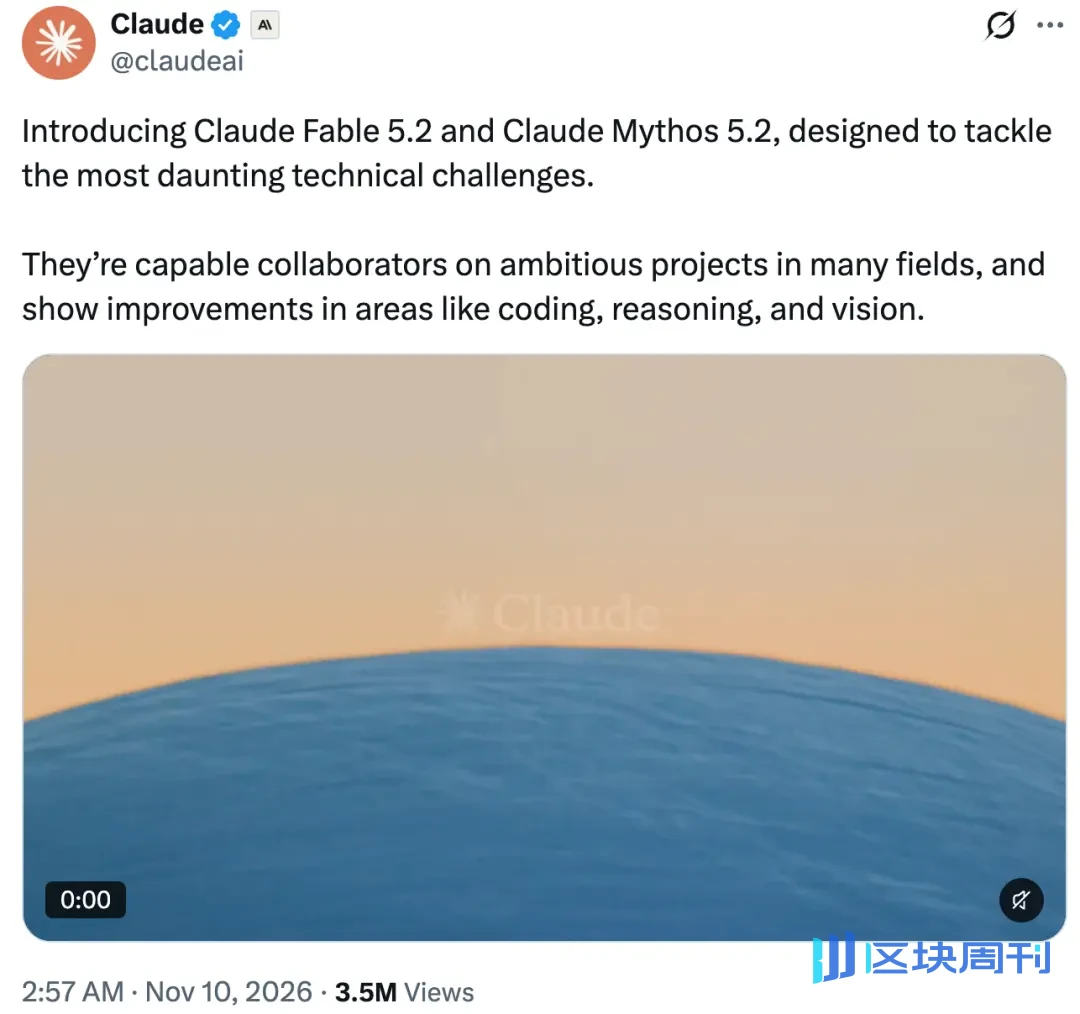
Anthropic still has a big move!
A historic moment repeats itself: Claude's internal model has cracked an 18-year-old open conjecture in quantum computing.
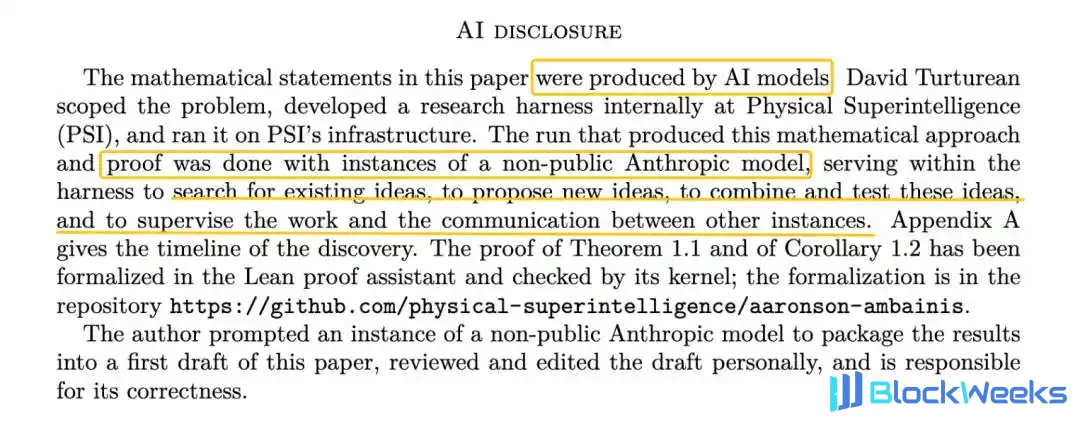
In just 3 days, a non-public Claude model cracked the Aaronson-Ambainis conjecture, which had remained unresolved since 2008!
Netizens speculate: this internal model seems to be the non-public version of the model, Claude Model 4.

The theorem and corollaries have been completed in Lean formalization, and the question of exactly how much advantage quantum computing has over traditional computing finally has an answer.
Claude punctures the myth of quantum supremacy
In 1994, Peter Shor proposed Shor's algorithm, which made a huge splash around the world.
It can factor large integers in polynomial time, whereas ordinary computers would need exponential time for this task.
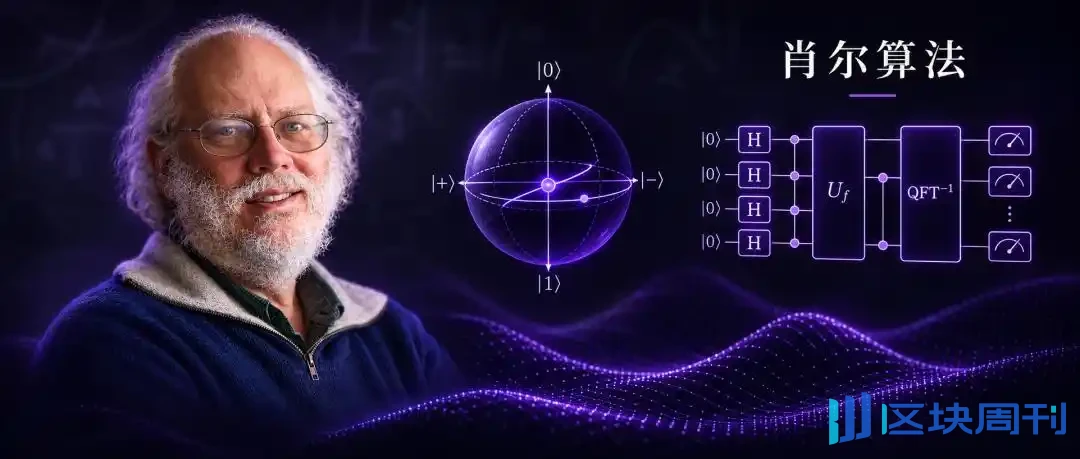
The cornerstone of the modern encryption system was thus shaken.
Shor's algorithm sounded the horn, and afterward the term "Quantum Supremacy" swept across the global tech world and capital markets.
A blueprint that made one's blood boil seemed to be right before our eyes: quantum superposition, quantum entanglement, exponential speedup.
It was as if as long as those fragile qubits were controlled well, humanity could launch an all-around dimensional strike and instantly step into a new era of nearly unlimited computing power.
A blind cognitive illusion began to spread:
As long as there is a quantum superposition state, it seems that for most difficult problems, quantum computers can also instantly traverse all possibilities and achieve an exponential critical hit.
Fortunately, physicists and computer scientists quickly realized: the reason Shor's algorithm can produce an "exponential crushing" is that behind integer factorization lies a strong periodic structure. And quantum computers are good at capturing this kind of repeating pattern.
But if the input data is completely random, without any pattern or special structure, can quantum computers still achieve exponential superiority?
In 2008, two leading scholars in the field of quantum computing—Scott Aaronson and Andris Ambainis—abstracted this physics and algorithm problem into a pure mathematics problem.
They compared the process of a computer reading input data to "observation."
Each time a classical computer reads a bit, it sees an exact "0" or "1"; a quantum computer, using superposition states, can spread a single observation across a massive number of states.
The two scholars found that the probability of a quantum computer outputting "yes" after T observations can essentially be rigorously characterized as a "bounded low-degree polynomial."

If it can be proved that such a polynomial must have a sufficiently large change when some variable is flipped, that is, that there exists a variable with significant influence, then it can be proved that: a classical computer only needs a polynomial-level additional cost to perfectly simulate the behavior of a quantum computer.
This is the famous Aaronson-Ambainis conjecture.

Now, this conjecture has been proved by AI, and in the future it may need to be called the "Aaronson-Ambainis theorem":

In their words:
Quantum computing still has many unsolved mysteries, but now, there is one fewer.

It should be noted that quantum supremacy has not disappeared, but this theorem has killed the "blind superstition" of quantum computing and clarified the P "legitimate territory" of quantum advantage.
The Oppenheimer Moment of Quantum Computing
The Physical Superintelligence that took action this time is not the first to act—
Last month, they solved five long-standing unresolved problems in quantum information theory.

Previously, Guy Blanc, Jordan Docter, Carmen Strassle of MIT and Li-Yang Tan of Stanford University solved a special case of a classical simulation corollary of this conjecture.
They had been reading the new proof and considered it just a "big result":
It solved a decades-old conjecture and has important implications for the essence of which problems can achieve quantum speedup.
This research involves several research directions in Boolean function analysis and probabilistic combinatorics.
And this proof is by no means "parroting"—it is absolutely not a matter of simply searching the literature to solve the problem, but rather a "rather wonderful way" that brought all the content together.
Perhaps experts from multiple fields working together could eventually prove this conjecture, but the speed of AI is beyond human reach!
According to reports, after the Harness system built around Anthropic's internal model was completed, the first proof was finished three days later.

It was then immediately sent into the Lean proof assistant for verification.
But that was not the end.
When the model instances were asked to use these intermediate results to tackle unresolved problems, they in turn polished these intermediate results, pressing the exponent down from 22 to 11, then to 7, continuously lowering it.

This is also a microcosm of the discovery process itself: the proof is not a sudden flash of inspiration, but a step-by-step approach to the optimal boundary through repeated polishing of intermediate results.
Physics and mathematics remain vast, the universe remains immense, and there are still many unsolved mysteries that humanity needs to explore.
But one thing is already certain:
In the expedition team exploring the rational frontier, humanity is no longer standing alone, solitary and shadowed only by itself.
References:
https://psi.inc/research/oqp-batch-2026/
https://psi.inc/research/aaronson-ambainis/
This article is from the WeChat public account "Xin Zhi Yuan", author: ASI Revelation